To satisfy my curiosity about AI, and ChatGPT in particular, I’ve been posing certain questions to it and been pleasantly surprised by the results. ChatGPT uses information that was publicly available online up to September 2021, so the responses that it generates will not include recent changes.
Here is one of my requests which, while much shorter, pretty well summarizes what I myself have written about the matter. I present it here for your information and your comments.
THG: Summarize the unique features of the work of Thomas H. Greco, Jr. on money and economics.
ChatGPT:
5/5 Thomas H. Greco, Jr. is known for his groundbreaking work on money and economics, focusing on alternative monetary systems and local economies. Some of the unique features of his work include:
- Decentralized Monetary Systems: Greco advocates for the development of decentralized and community-based monetary systems that empower individuals and local communities to create their own means of exchange. He emphasizes the importance of currencies that are not controlled by centralized authorities like governments or banks.
- Complementary Currencies: Greco promotes the idea of complementary currencies, which are designed to work alongside national currencies to facilitate local transactions and trade. These currencies are often tailored to specific communities or regions and can help stimulate local economies.
- Democratization of Money Creation: He challenges the conventional model of money creation by banks and governments. Greco believes in the democratization of money issuance, allowing communities to create their own money based on real value and resources.
- Mutual Credit Systems: Greco’s work includes the concept of mutual credit systems, where participants can extend credit to one another within a network. This can foster cooperation and exchange without the need for traditional banking intermediaries.
- Localized Economies: He emphasizes the importance of localized economies that prioritize community resilience and sustainability. Greco’s work encourages communities to rely more on local production and resources to reduce dependency on distant supply chains.
- Interest-Free Economics: Greco criticizes the conventional practice of charging interest on loans and believes that interest-free systems could lead to more equitable distribution of wealth and resources.
- Advocacy for Change: Through his writings and lectures, Greco advocates for individuals, communities, and governments to explore and implement alternative economic and monetary systems. He believes that a shift away from the current monetary paradigm could lead to more just and sustainable economies.
In summary, Thomas H. Greco, Jr.’s work revolves around reimagining money and economics by proposing alternative monetary systems, promoting decentralized currencies, advocating for interest-free economies, and encouraging the development of localized, community-based economic structures. His ideas challenge conventional economic thinking and aim to create more resilient, equitable, and sustainable societies.
# # #
Update: Monday, August 28, 2023
This iteration is a bit more complete:
Thomas H. Greco, Jr. is known for his unique contributions to the fields of money and economics, particularly in the realm of alternative currencies and monetary systems. Some of the key features of his work include:
- Local and Complementary Currencies: Greco emphasizes the importance of local and complementary currencies as tools for promoting economic resilience and community development. He advocates for the creation of currencies that are tailored to specific communities or regions, helping to stimulate local economic activity and reduce dependence on centralized national currencies.
- Decentralization of Money Creation: A central theme in Greco’s work is the decentralization of money creation. He believes that allowing communities to create their own currencies empowers them to meet their specific needs, bypassing the traditional centralized banking system and enabling greater control over their economic destiny.
- Credit Clearing Systems: Greco explores the concept of credit clearing systems, which facilitate transactions without the need for traditional currency. These systems work by enabling participants to exchange goods and services directly based on mutual credit agreements, reducing the reliance on scarce official currency.
- Integral Theory and Economics: Greco integrates principles of integral theory into his economic thinking, considering not only economic factors but also social, ecological, and cultural dimensions. He emphasizes the need for a holistic approach to economics that takes into account the interconnectedness of various aspects of human life.
- Monetary Reform Advocacy: Greco is an advocate for monetary reform, particularly in response to issues such as inflation, financial instability, and wealth inequality. He proposes alternative monetary systems that prioritize stability, fairness, and sustainability.
- Educational Efforts: Beyond his academic work, Greco is involved in educational efforts to raise awareness about alternative currencies and monetary systems. He has authored books and conducted workshops to help individuals and communities better understand and implement these concepts.
- Focus on Empowerment: One of the overarching themes of Greco’s work is empowering individuals and communities to have a greater say in their economic affairs. He believes that by rethinking the way money is created and circulated, people can gain more control over their economic lives and reduce their vulnerability to systemic financial crises.
- Sustainability and Resilience: Greco’s work aligns with the principles of sustainability and resilience. By promoting local economies and alternative currencies, he aims to create systems that are more environmentally friendly and less susceptible to the boom-and-bust cycles of traditional monetary systems.
In summary, Thomas H. Greco, Jr.’s work on money and economics revolves around the development of local and complementary currencies, decentralization of money creation, credit clearing systems, integral theory integration, monetary reform advocacy, educational initiatives, empowerment, and a focus on sustainability and resilience. His ideas challenge conventional economic thinking and offer potential solutions for creating more equitable and community-driven economic systems.
# # #

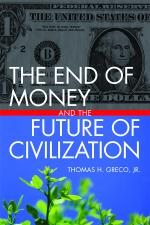 as relevant today as it was when first published the printed book has been out of print for several years. But, having had the rights reverted to me by my publisher, I am making the entire book available for free in PDF format. You can read it or download it HERE. If you would like a hard copy of the first edition used copies can still be found on Amazon.com, Abe books, Thrift books and elsewhere.
 Better still, you can avail yourself of the new revised and expanded 2024 edition which I have been working on for almost two years and is almost complete. Eighteen chapters have already been posted and can be freely read or download HERE.
 Beyond Money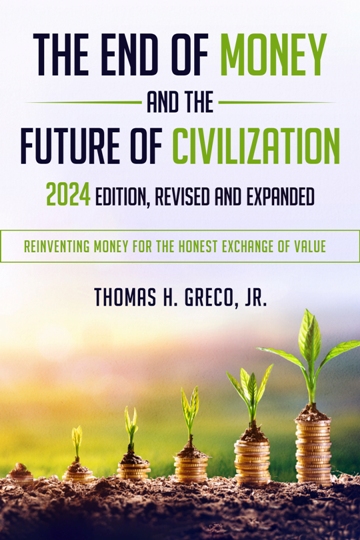
 Beyond Money