Category Archives: Developing Alternatives

Legal obstacles to moving your money

Now, more than ever, it is imperative that people move their available financial resources away from conventional Wall Street investments that offer the illusion of security toward real assets that can provide real security in basic living essentials. There are however legal obstacles that limit our ability to do that.

One of the best resources for information about that is Cutting Edge Capital. The September 2011 newsletter is a good place to start. Be sure to listen to Jenny Kassan’s presentation, ACCELERATING COMMUNITY CAPITAL WORKSHOP: The Legal Landscape, given at the recent BALLE conference.

More about Iceland’s ongoing revolution

This article, Iceland’s On-going Revolution, by Deena Stryker, provides additional information and inspiration.

New Moneeey

I recently came across a series of video animations titled, New Moneeey, which, it turns out, are pretty good. New Moneeey appears to be a group effort but John Ince seems to be a key player. I met John a couple years ago when he came to one of my lectures in San Francisco. I lost track of him for a while but we’ve recently reconnected. I’ve not tried to verify all of the statements made in the videos, but even if off by a factor of 10, they are significant.

John’s credentials are quite impressive. They include a Harvard MBA and whole raft of accomplishments in writing, media, and entrepreneurship. He is the author of two recently published books, The Money Question, and Meaningful Money, and is in the process of preparing a new book, The Wizard of Iz.

Here is the first part of the New Moneeey series. You may want to watch the entire thought provoking series.

Money and Life: An exciting upcoming documentary

 I’ve had the honor to be included in the list of people interviewed for a new documentary film, Money and Life, which has been in preparation for more than two years. Scheduled for release early next year, it is being billed as “A story about money that will change your life.” Judging from the official description and recently released trailer below, it looks like it just might live up to that billing.—t.h.g.

MONEY & LIFE is an essay style documentary that investigates the many faces of money. This cinematic odyssey takes us on a journey, exploring the origins of money to connecting the systemic dots on the current global financial crisis and how we got here. But most importantly looking at what is emerging in the so-called New Economy.

In addition to exploring perspectives on money and the workings of the money system we ask the viewer to engage and examine their own assumptions and beliefs about money, attempting to unearth and make visible the implicit and explicit agreements we have made around money and how it has come to govern our lives in ways that create suffering and dissatisfaction. The central thesis is understanding that different monetary designs produce different results in human society and in the natural world. If that is really so, then what is possible?

We interview an all-star cast of deeply engaged global citizens.

You can view the trailer here:

http://vimeo.com/moogaloop.swf?clip_id=24227019&autoplay=true


Coping, caring, and building community

As the financial and economic ground continues to shift beneath our feet, it becomes ever more imperative that we reduce our dependence upon the institutions and structures that we have come to depend upon and take for granted. The financial tsunami of 2008 and the continuing aftershocks should be a wakeup call. The sock markets may be up (for now), but that should not be taken as comforting evidence that everything is “getting back to normal.” As billionaire financier George Soros said in his recent book, “This crisis …has brought the entire [financial] system to the brink of a breakdown, and it is being contained only with the greatest difficulty. This will have far reaching consequences. It is not business as usual but the end of an era.” (The New Paradigm for Financial Markets: The Crash of 2008 and What it Means. p. 81).

The total outstanding credit for all sectors in the U.S. economy was 160% GDP in 1929, 260% in 1932. By comparison, we entered the 2008 crash at 365%, and Soros believes this will rise to about 500% of GDP within the next few years.

What seems to be in prospects for the foreseeable future for the vast majority of people in the developed world, especially the United States, is diminished purchasing power. This the result of simultaneous trends of underemployment or unemployment, rising prices of basic necessities due to currency debasement (inflation), and systematic attacks on the middle-class by the political establishment.

How do we cope with all of that? It is, of course, as the proverb says, both a challenge and an opportunity. I have suggested before that society is on the verge of metamorphic change that offers the promise of a more peaceful and harmonious world in which basic needs are met and everyone has the opportunity to realize their fullest potential. But it will take the right kind of action to make that vision a reality. It will require that we take sharing and cooperation to new levels, and that we create new structures that can serve the common good. An essential part of that is building community.

On that score, I take inspiration from Richard Flyer and the Conscious Community Network. Richard recently posted a list of 37 ways to build community. No Act is Too Small! You can click on that link to learn more, but I have extracted the 37 ways here for your convenience. I’m sure Richard won’t mind.—t.h.g.

1. A smile and a wave will go a long way.

2. Each morning, ask where you can make a difference.

3. Find the good in others instead of their faults – start in your home and on your street.

4. Become aware of hidden needs on your street – isolated seniors;

youth needing mentors, single parents; etc.

5. Start a community garden.

6. Practice forgiveness.

7. Surprise a new neighbor by making a favorite dinner – and include the recipe.

8. Slow down and enjoy the present moment.

9. Don’t gossip.

10. Start a monthly tea group.

11. Play cards with friends and neighbors.

11. Start a babysitting cooperative.

12. Form a group of neighbors to walk their dogs together.

13. Seek to understand.

14. Start a carpool.

15. Have family dinners and read to your children.

16. If you grow tomatoes, plant extra for a lonely elder who lives nearby – better yet, ask him/her to teach you and others to can the extras.

17. Turn off the TV, Play Station, PSP, and talk with family, friends, and neighbors.

18. Bless your food with gratitude.

19. Know that love is not a feeling but a courageous choice.

20. Ask neighbors for help and reciprocate.

21. Talk to your children or parents about how their day went.

22. Say hello to strangers.

23. Create a neighborhood newsletter.

24. Organize a neighborhood clean-up.

25. Be a model and demonstrate the virtues you want to see in the world.

26. Be a peacemaker.

27. Talk to the mail carrier.

28. Shoot some ‘hoops with neighbor children.

29. Support local merchants.

30. Speak kindly and listen carefully

31. Hire young people for odd jobs.

32. Form a tool cooperative with neighbors and share ladders, rakes, snow blowers, etc.

33. Grow your own food.

34. Be real. Be humble. Be respectful.

35. Offer to watch your neighbor’s home or apartment while they are away

36. Be of service to all.

37. Go to http://www.consciouscommunity-reno.org/ to share your stories.

Adapted from http://bettertogether.org.

Liberty Dollar conviction no threat to “barter” exchanges

In the wake of the recent Liberty Dollar case, there has been much concern and confusion about what it means to the alternative exchange and local currencies movement. Here is a clarifying statement that has just been issued by the International Reciprocal Trade Association (IRTA), the trade association for the commercial “barter” industry.

Liberty Dollars Case Does Not Involve the Modern Trade & Barter Industry

No Government Precedent Set Against Private Barter Currencies

Recent news stories suggesting that the Liberty Dollars verdict is a signal that the Government is against private barter currencies are categorically incorrect and ignore the facts of the case.

On March 18, 2011, after a six day trial, a North Carolina jury found the defendant Bernard von NotHaus guilty of making coins resembling and similar to United States coins; of issuing, passing, selling, and possessing Liberty Dollar coins; of issuing and passing Liberty Dollar coins intended for use as current money; and of conspiracy against the United States.

In the trial, the defense improperly tried to argue that Mr. NotHaus’s Liberty Dollar coins represented legitimate voluntary private barter currency transactions. But the government and jury rejected that misplaced argument; “there can be no private currency system that functions through the private creation and distribution of counterfeit coins designed in resemblance and similitude of United States coins.” (Government Brief filed on April 7, 2011 in by U.S District Court by U.S. Attorney Anne M. Thompkins).

Several news stories have highlighted an irresponsible quote made by Liberty Dollar’s counsel, Aaron Michel, which said:

“The prosecutors successfully painted Mr. von NotHaus in a false light and now the U.S. Attorney responsible for the prosecution is painting the case in a false light, saying that it establishes that private voluntary barter currency is illegal.”

However, the fact is that the Government rejected any comparison of VonHaus’s counterfeiting activities with legitimate barter currencies. As the Government stated in their U.S. District Court Brief of April 7, 2011; “the defendant was not operating a private currency barter system, rather he was counterfeiting United State coins and using deceptive means to inject them into the flow of current money to defraud the public.” (Page 5.) Further on page 13, the Government states ” the evidence at trial clearly demonstrated that the activities surrounding the creation and distribution of the Liberty Dollars were in no way a competing private voluntary currency system, but rather constituted a deceptive and fraudulent scheme designed and implemented by the defendant.” Lastly, on page 14, the Government goes on to say, “any comparison of Defendant’s creation and distribution of Liberty Dollar coins to localized private exchange systems such as the Ithaca Hour or Disney Dollar are absurd on their face.”

IRTA moved quickly to set the record straight and was successful in getting the following clarifying statement inserted in a revised version of the http://www.examiner.com article by Mr. Schortgen:

Executive Director of IRTA, Ron Whitney says, “Mr. Michel’s quote suggesting that the Liberty Dollar case is related to the legally recognized organized barter industry is misplaced. The IRS website at http://www.irs.gov/businesses/small/article/0,,id=187904,00.html defines barter as “the trading of one product or service for another.” The Liberty Dollar’s case is not about trading one product or service for another, rather it is about violation of Section 18, 486 of the U.S. Code which prohibits the manufacture of coinage or metals intended as current money resembling coinage of the U.S. Mr. vonNotHaus was convicted of the charges of counterfeiting and making and selling currency, barter had nothing to do with the case. The modern trade and barter industry was recognized by the U.S. government as a legal alternative form of commerce by the Tax Equity and Fiscal Responsibility Act (TEFRA), passed in 1982 whereby barter exchanges were deemed third party record keepers and required to comply with IRS 1099B reporting laws. Barter sales conducted through barter exchanges are taxable sales reported annually to the IRS. The Liberty Dollar’s verdict is completely separate from the legally recognized modern trade and barter industry and in our view it does not represent an effort on the government’s part to declare valid TEFRA compliant barter transactions as illegal activity.”

We trust the information above will operate to clear the confusion on this matter. Please call Ron Whitney at 757-393-2292 if you have any questions.

Stop Chasing the Buck and Change Your Luck

Cashless trading based on credit clearing is moving into its next stage of development, the optimization and scale-up stage.

Established groups and associations are beginning to recognize the importance and urgency of disengaging from conventional structures of money and banking, reclaiming “the credit commons,” and reorganizing the exchange of value under local community control. One such association is Green America, formerly known as Coop America, which has recently established  The Green America Exchange  as a way of offering cashless trading opportunities to members of their Green Business Network.

GAEx uses the GETS trading platform which has been developed by Richard Logie, a long-time commercial trade exchange operator and leader in the industry. While the GETS software is proprietary, it seems to have the functionality needed for cashless trading within the exchange. According to Logie, the platform also has the capability needed for networking similar exchanges together into a larger more widespread trading community.

In response to a request from the Green America administration I’ve written the following article for posting (in four parts) on the Green America Exchange blog. For your convenience, I’ve also posted it below.–t.h.g.

Stop Chasing the Buck and Change Your Luck

Thomas H. Greco, Jr.

Most small and medium sized businesses (SMEs) these days are having a hard time financially–sales are down, costs are up, and bank credit is unavailable, all of which is symptomatic of the stagflation that besets the American economy.

Our present predicament is no accident of nature, nor is it a temporary condition; it is the expected result of a flawed system of money, banking and finance. We have allowed the banks to control our credit and charge us interest for the “privilege” of accessing some of it as bank “loans.” The fact is that the dollar regime, like every other political currency, collectivizes credit. It is the people’s collective credit that supports each national currency, but the allocation of that credit is determined by forces beyond popular control, and an inordinate proportion of it is used to fund the war machine and to enrich corporate fat cats, all to the detriment of peace, equity, and the common good.

But we need not be victims of a system that is so obviously failing us. We can learn to play a different game. It is possible to organize an entirely new structure of money, banking, and finance, one that is interest-free, decentralized, and controlled, not by banks or central governments, but by businesses and individuals that associate and organize themselves into cashless trading networks. This is a way to reclaim “the credit commons” from monopoly control and create healthy community economies that can enhance the quality of life for all.

In brief, any group of traders can organize to allocate their own collective credit amongst themselves, interest-free. This is merely an extension of the common business practice of selling on open account—“I’ll ship you the goods now and you can pay me later,” except it is organized, not on a bilateral basis, but within a community of many buyers and sellers. Done on a large enough scale that includes a sufficiently broad range of goods and services, such systems can avoid the dysfunctions inherent in conventional money and banking and open the way to more harmonious and mutually beneficial trading relationships that enable the emergence of sustainable economies and promote the common good—a true economic democracy.

This approach is no pie-in-the-sky pipedream, it is proven and well established. Known as mutual credit clearing, it is a process that is used by scores of commercial “barter” companies around the world to provide cashless trading for their business members. In this process, the things you sell pay for the things you buy without using money as an intermediate exchange medium. Instead of chasing dollars, you use what you have to pay for what you need. It’s as simple as that. Unlike traditional barter, which depends upon a coincidence of wants and needs between two traders who each have something the other wants, mutual credit clearing provides an accounting for trade credits, a sort of internal currency, that allows traders to sell to some members and buy from others. According to the International Reciprocal Trade Association (IRTA), a major trade association for the industry, “IRTA Member companies using the ‘Modern Trade and Barter’ process, made it possible for over 400,000 companies World Wide to utilize their excess business capacities and underperforming assets, to earn an estimated $12 billion dollars in previously lost and wasted revenues.”

Perhaps the best example of a credit clearing exchange that has been successful over a long period of time is the WIR Economic Circle Cooperative. Founded in Switzerland as a self-help organization in the midst of the Great Depression (1934), WIR provided a means for its members to continue to buy and sell to one another despite a shortage of Swiss francs in circulation. Over the past three quarters of a century, in good times and bad, WIR (now known as the WIR Bank) has continued to thrive. Its more than 60,000 members throughout Switzerland trade about $2 billion worth of goods and services annually.

Now the Green Business Network of Green America, is offering that kind of opportunity to its membership through Green America Exchange, GAEx. While still in the formative stages, Green America Exchange has the potential to become, not merely a lifeboat for SMEs in difficult times, but a model for a new paradigm in business.

The challenge for any network, of course, is to achieve sufficient scale to make it useful. The bigger the network, the more opportunities it provides for cashless trades to be made. In the early stages, it may require some help to find those opportunities, but as the members discover each other and become aware of what each has to offer, the value proposition becomes ever more evident and more businesses are attracted to it. Like Facebook, Twitter, My Space and other networks that are purely social, cashless trading networks will eventually grow exponentially –and that will mark a revolutionary shift in political as well as economic empowerment. It will be a quiet and peaceful revolution brought on, not by street demonstrations or by petitioning politicians who serve different masters, but by working together to use the power that is already ours—to apply the resources we have to support each other’s productivity and to give credit where credit is due.

Through participation in an exchange network that is open, transparent and democratic members enjoy the benefits of:

  • A reliable and friendly source of credit that is interest-free and community controlled.
  • Less need for scarce dollars.
  • Increased sales.
  • A loyal customer base.
  • Reliable suppliers.

What will it take to make mutual credit clearing networks go viral the way social networks have? That is the key question, the answer to which has heretofore remained elusive. While the WIR has been an obvious success, it seems to have been intentionally constrained and prevented from spreading beyond Swiss borders, and while commercial “barter” has been significant and growing steadily, it is still tiny in relation to the totality of economic activity.

As they are operated today, commercial trade exchanges are self-limiting and typically impose significant burdens upon their members. These include onerous fees for participation, exclusive memberships, limited scale and range of available goods and services within each exchange, the use of proprietary software, and insufficient standardization of operations which limits the ability of members of one trade exchange to trade with members of other exchanges.

Virtually all commercial trade exchanges are small, local, and operated as for-profit businesses. Small scale, local control, and independent enterprise are all desirable characteristics, but when it comes to exchanging valuable goods and services, something more is needed. What the world needs now is a means of payment that is locally controlled but globally useful.

Here are the things that I think are needed for cashless trading based on mutual credit clearing to go viral:

  1. Members need to offer to the network, not only their slow moving merchandise and luxury services, but their full range of goods and services at their usual prices. This will assure the value of the internal trade credits and make them truly useful.
  2. Like any “common carrier,” trade exchanges should make membership open to all with little qualification.
  3. Lines of credit (the overdraft privilege) must be determined according to each member’s ability and willingness to reciprocate, measured for example, by her record of sales into the network.
  4. Trade exchanges must be operated for and by the members in a way that is transparent and responsive.
  5. Members must exercise their duties to provide proper oversight and supervision of those assigned to manage the exchange.

As soon as there is a model exchange that has mastered these dimensions of design and operation, its success will inspire others to follow suit and the rapid growth phase will begin, leading eventually to an internet-like global trading network that will make money obsolete. Perhaps Green America Exchange will become that model.

#     #     #

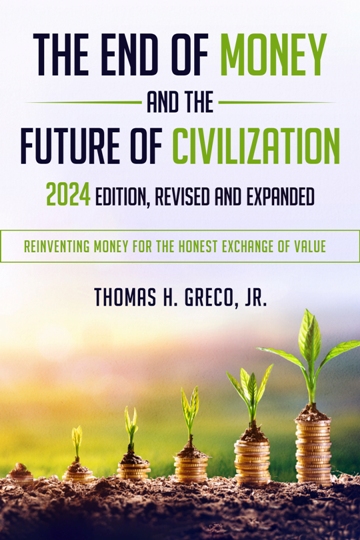
Thomas H. Greco, Jr. is a writer, networker, and consultant, specializing in cashless exchange systems and community economic development. A former engineer, entrepreneur, and tenured college professor, he is widely regarded as a leading authority on free-market approaches to monetary and financial innovation, and is a sought-after advisor and speaker at conferences internationally. He is the author of many articles and books, including The End of Money and the Future of Civilization (Chelsea Green, 2009) and Money: Understanding and Creating Alternatives to Legal Tender (Chelsea Green, 2001). His blog, https://beyondmoney.net/, and website, http://reinventingmoney.com/, are valuable resources that provide detailed explanations and prescriptions for communities, businesses, and governments.

Liberty Dollar founder Bernard von NotHaus on Peter Schiff Show Friday April 1

This is just in from Bernard von NotHaus

Dear Liberty Dollar Supporters!

If you have been appalled with the government’s comments trying to paint me as a “unique terrorist,” you are not alone. The gov is now trying to brand all local non-government currencies as illegal and anybody who expresses opposition to the current US monetary policy is a “unique terrorist.” Since the Liberty Dollar trial the word “terrorist” has lost any rational meaning and has morphed to simply mean, “doing something the government doesn’t like.”

Seth Lipsky’s article in The New York Sun regarding a “Unique form of Terrorism” confirms the gov’s intention to tailor “terrorism” to any definition they want or need for any occasion. As a result, the adverse reaction to government’s “terrorist” comments has generated a tremendous “blow back” in their face.

So I am pleased to announce I will be a guest on the Peter Schiff Show at 11:00, this Friday, April 1, 2011. This is the first time I have spoken publicly since my conviction. The interview will be very informative so I urge you to tune into Peter’s live radio show at http://www.schiffradio.com/. The show’s toll free number is 866.226.5620.

For over twenty years, Peter Schiff has been the forerunner to accurately forecast the U.S. stock market, economy, real estate, the mortgage meltdown, credit crunch, sub-prime debacle, commodities, gold and the dollar. He has distinguished himself as an expert on money, economic theory, and international investing. Peter’s best-selling book, “Crash Proof: How to Profit from the Coming Economic Collapse” has cast him as a legend in predicting the course of the US dollar and what is best for your money.

I have been consistently impressed with Peter’s investment advice and his dedication to those values that the Liberty Dollar represents. It is an honor to be on his show.

Please note: Currently, Peter Schiff is President and Chief Global Strategist for Euro Pacific Capital that is not affiliated with or responsible for the content of SchiffRadio.com.

I hope you can join Peter and I for an engaging interview – one not to be missed!

Bernard von NotHaus

Catch it if you can. — t.h.g.

Monetary Reformer Convicted in Liberty Dollar Case

According to an FBI press release dated March 18, 2011, Bernard von NotHaus, 67, founder of NORFED and creator of the Liberty Dollar silver coin, has been convicted by a federal jury of “making, possessing, and selling his own coins.” The conviction of von Nothaus demonstrates just how far through the looking glass we have gone. According to the US government, anyone who advocates monetary reform (or any sort of government reform) may be a “terrorist.”

Here is a chilling quote from the FBI press release:

“Attempts to undermine the legitimate currency of this country are simply a unique form of domestic terrorism,” U.S. Attorney Tompkins said in announcing the verdict. “While these forms of anti-government activities do not involve violence, they are every bit as insidious and represent a clear and present danger to the economic stability of this country,” she added. “We are determined to meet these threats through infiltration, disruption, and dismantling of organizations which seek to challenge the legitimacy of our democratic form of government.”

It is evident that Ms. Tompkins has no idea what “legitimate currency” is, or that what she purports to be protecting is anything but “our democratic form of government.” The actual situation is well stated by J. Neil Schulman in his recent post at Rational Review:

“If there is such a thing as economic terrorism, it has been conducted without punishment by the financial elites who own and operate the Federal Reserve Bank. For the Department of Justice of the United States to overlook this mega-crime and prosecute a man whose goal was to enforce the law as written in the Constitution they have taken an oath to obey is an obscene reversal of fact and language. If there is such a thing as economic terrorism, the Federal Reserve is the economic equivalent of al-Qaeda, and its ravaging of the economy is the 9/11 of U.S. economic history.” (03/22/11)

This case is far from settled, and will hopefully serve to revive the political debate about money and finance, and ultimately advance the cause of free money and free banking.

By the way, Glenn beck will plug G. Edward Griffin’s book, The Creature from Jekyll Island, on Friday 2011 March 25. The entire Glenn Beck show that day will be devoted to an exposé of the Federal Reserve. The Glen Beck program is aired weekdays on Fox News at 5 PM Eastern time. –t.h.g.

States beginning to assert their money power

Bills have recently been introduced in several states to try to address the money problem. In an article that appeared in Financialsense.com, Robert Kientz describes actions that are occurring in several states. It is unclear how much support the various bills might have, or what their chances of passage might be, but Kientz implies that the state of Virginia has already taken official action to at least study the matter of using alternative payment media other than Federal Reserve currency. He says:

Virginia announced yesterday that the state would commission a study of alternative currencies including gold and silver in House Joint Resolution No. 557. A selected quote from Resolution 557:

WHEREAS, the Supreme Court of the United States in Lane County v. Oregon, 74 U.S. (7 Wallace) 71, 76-78 (1869), and Hagar v. Reclamation District No. 108, 111 U.S. 701, 706 (1884), has ruled that the States may adopt whatever currency they desire for the purposes of performing their sovereign governmental functions, even to the extent of adopting gold and silver coin for those purposes while refusing to employ a currency not redeemable in gold or silver coin that Congress has designated “legal tender”;

Such actions are a hopeful sign that the money power, and the political power that goes along with it, are devolving away from Wall Street and Washington and back to our states and communities. The states have a powerful weapon in the form of the United States Constitution, which declares that, no state shall make any thing but gold and silver Coin a Tender in Payment of Debts.

Of the two metals, I much prefer silver as the value standard, for several reasons. My main objection to gold is that it is closely held by a few banks and governments that are able to manipulate its market price, and thus manipulate the economy if gold were to play a major monetary role. Silver is much more abundant and widely held, and while present market mechanisms enable a few entities to manipulate its market price, I think parallel  mechanisms can be put into place that would assure a freer market giving silver a more stable value. Ideally, however, trading entities will ultimately adopt an objective value measure using a composite commodity standard composed of a “market basket” of basic commodities.

Keynes was not wrong in calling gold “a barbarous relic,” but that’s not the whole story. We must also recognize that central banks, legal tender laws, and credit monopolies are relics even more barbarous than gold. The separation of money and state must ultimately be gained in order to have a truly free and harmonious society.