The US dollar is rapidly losing its status as the global “reserve currency.” One after another, nations outside of the western coalition are waking up to the fact that dollars are needed only to pay for imports that come from the United States. In trades with other countries they are choosing to begin paying one another by using their own currencies, as reported in videos like this. They are recognizing that the real resources that they own are much more valuable than the empty promises that are embodied in inflated US dollars or other political currencies. The exploitation of weaker nations by the western powers that has been ongoing for centuries is coming to an end and the emergence of a multi-polar world order is now unstoppable.
The Bretton Woods agreement that established the post-war world financial order in 1944 was based on the promise that US dollars would be redeemed for gold at $35 an ounce. But the continuous debasement of the dollar over the years made that completely unrealistic, and ultimately its impossibility was formally recognized when President Nixon in 1971 “closed the gold window” and announced that the US government was reneging on that commitment. It would no longer give gold for dollars except at the prevailing market price. From that point on the fate of the dollar was sealed; it was just a matter of time. Despite the imposition of a series of extreme financial, economic, political, and military measures by the US and its western allies, time has run out on dollar dominance and the unipolar world order.
The main questions now are, 1) to what further extremes will the western empire resort in its desperate effort to forestall the inevitable political reordering, and 2) what sorts of new monetary and financial arrangements will be established to supplant the old Bretton Woods arrangement?
Regarding the first of these, the past several decades have seen a succession of both covert and overt interferences designed to weaken or neutralize monetary dissidents and potential political and economic rivals. Notable among the former have been Saddam Hussein, who in 2000 began selling Iraqi oil for Euros instead of dollars, and Muammar Gaddafi the Libyan leader who had plans to launch a pan-African currency called the Gold Dinar to free Africa from American domination. As a consequence, both men were murdered and their countries destroyed. Following the NATO invasion of Libya, and the murder of Gaddafi, then Secretary of State, Hillary Clinton, disgustingly and arrogantly boasted, “We came, we saw, he died!”
But nuclear armed Russia and China are not so easy to push around and brought to heel. When their Russian puppet Boris Yeltsin chose Vladimir Putin to succeed him as prime minister, the globalist western oligarchs thought they could continue to rape Russia and exploit its vast resources for their own purposes. But Putin surprised them with his loyalty to “Mother Russia” and his unwillingness to betray the Russian people to the globalists. Whatever we in the west might think about the man, his stance has clearly endeared him to the Russian people.
When the Soviet Union collapsed, the western powers promised not to move NATO farther to the east, but they have reneged on that promise, and one by one have brought the former Soviet republics into the western fold. [Robert F. Kennedy Jr. has elaborated on this point in his recent speech and highlighted the importance of respect for Russia’s legitimate security concerns if ever there is to be peace]. Then, in 2014 the CIA engineered the overthrow of the elected government in Ukraine and replaced it with their own puppet government to further pressure the Russian government to play ball. The perceived existential threat of NATO weapons, even nuclear ones, on their very doorstep, was too much for Russia’s leadership to bear. It should have come as no surprise to anyone that the Russians reacted as they did to counter that threat by launching their “special military operation.” Putin had stated repeatedly that he hoped to negotiate a deal that would respect Russia’s national security interests but the US government has chosen to perpetuate the war in order to weaken Russia and force it to submit. Former nuclear weapons inspector, Scott Ritter, with his military experience and vast knowledge of the region provides a much more nuanced picture of that siltation than the biased sound bites one typically gets from the mainstream media.
Farther to the east, China a major economic, political and military power, has also balked at submitting to a New World Order in which the Western Empire calls all the shots. So now the globalist oligarchs who control the US government see China as a major obstacle to their plan for establishing a trans-human, technocratic utopia under the control of the elite Super Class. Hence, we see continual saber rattling, military and political provocations, and endless prating about the “Chinese threat.”
Regarding a new system of exchange and finance, I expect that we may soon see the emergence of a multilateral system for clearing credits among nations, one that will be more along the lines of the Bancor plan that John Maynard Keynes proposed at Bretton Woods in 1944. Not that Keynes should be the last word on the matter, but he at least proposed a way of preventing trade deficits from becoming perpetual as they are now, by imposing a levy (interest) on positive balances, as well as negative balances, that would seem to eliminate the debt trap. Professor Perry Mehrling provides a brief description of the Bancor plan in this video.
I expect eventually to see the complete depoliticisation of money and the broader application of credit clearing directly among buyers and sellers at the level of individual traders, as they have been doing for decades through the scores of commercial trade exchanges that have been operating around the world. Money is, after all, merely an information system about credits and debits that enables goods and services that are sold to pay for other goods and services that are bought. Further, the settlement of accounts will be done not only through reciprocal exchange, but also through cooperative support and forgiveness of debts, which will bring with it greater fairness and finally a peaceful world. Indeed, there may someday be a world government, but it will not be imposed by force, nor will it be the product of greed and materialistic human minds.
# # #
Addendum: In this excellent article, America Has Just Destroyed a Great Empire, Prof. Michael Hudson offers a history lesson that underlines the points I’ve made in my article.
Here is a small excerpt:
Having endowed the region’s cosmopolitan Temple of Delphi with substantial silver and gold, Croesus asked its Oracle whether he would be successful in the conquest that he had planned. The Pythia priestess answered: “If you go to war against Persia, you will destroy a great empire.”
Croesus therefore set out to attack Persia c. 547 BC. Marching eastward, he attacked Persia’s vassal-state Phrygia. Cyrus mounted a Special Military Operation to drive Croesus back, defeating Croesus’s army, capturing him and taking the opportunity to seize Lydia’s gold to introduce his own Persian gold coinage. So Croesus did indeed destroy a great empire, but it was his own.
Fast-forward to today’s drive by the Biden administration to extend American military power against Russia and, behind it, China. The president asked for advice from today’s analogue to antiquity’s Delphi oracle: the CIA and its allied think tanks. Instead of warning against hubris, they encouraged the neocon dream that attacking Russia and China would consolidate U.S. control of the world economy, achieving the End of History.
But that’s not the way it’s working out. Please read the full article.
____________________________ The Emerging New Civilization
Is our civilization collapsing? If so, what can be done about it? Can it still somehow be saved? If, not, what will be the impact on people in various places and cultures? What sorts of new systems and structures will emerge to take the place of the old?
These are some of the questions that my longtime friend and correspondent, Prof. Jem Bendell, addresses in his new book titled, BREAKING TOGETHER – a freedom-loving response to collapse. Having received and read an advance copy, I’ve been deeply impressed with the depth of Jem’s research and clarity of vision, and moved by his personal story of mind-change and commitment to advancing the common good. Far from doom and gloom, the message of this book is hopeful and inspiring.
In his introductory chapter, Recognising and Responding to Collapse, Prof. Bendell addresses these topics:
Finding our bearings in a world that’s lost
What is collapsing?
Why is this perspective not widely known?
Allowing the emotion of it all
From repentance to radicalization
Freedom from the failing of fables
Freeing humanity to our true nature
Breaking together
I strongly recommend that you listen to a reading of that chapter at SoundCloud. For information on purchasing Prof. Bendell’s, book, or to receive a free copy as an e-book, go to his website.
“Backlash against the COVID-19 fiasco of the last three years is building among a public that is slowly waking up to the unprecedented power grab and wealth transfer that took place under cover of a pandemic.”
“Can a coalition be built in a divided and suffering population to combat the political and economic nexus — namely the corrupt merger of state and corporate power — that is ruining the health of the people and the planet, and trampling our rights and freedoms in the process?”
“He (Prof. Jem Bendell) writes (in his new book, Breaking Together) that “climate concern is being highjacked by a mix of corporate profiteers and authoritarians, so that ineffective and counterproductive policies are being implemented and thereby generating a backlash against any kind of concerted action.”
His proposed solution is to reboot environmentalism into an “eco-libertarian” movement that seeks to protect both our freedoms and the environment from big corporations, corrupt governments and Davos elites.”
“In the overlap between the Left and Right versions of the popular revolt against the corrupt merger of state and corporate power, laid bare by the glaring abuses of the COVID-19 era, there may be room for unexpected political bedfellows to build a broad-based movement that appeals to significant segments of the electorate.”
Indeed, I’ve been seeing the emergence of what may become “a new grassroots populist majority that transcends the old boundaries of left, right, and green, liberal and conservative, rural and urban.” If we are to save democracy, the environment, and our very humanity, and build a just and equitable “new civilization,” we must overcome our knee-jerk reactions, listen deeply to each other, look at all the evidence, and build new alliances that transcend old labels and political rivalries. ____________________________ Fifth generation warfare and Sovereignty
“Fifth generation warfare is a war of information and perception,” and you are the enemy. In his excellent presentation, Dr. Robert Malone outlines the strategies, tactics, and technologies that are being used by “the national security state” to manipulate people’s emotions, and shape our thoughts, attitudes, values, and beliefs. He states that, “In fifth generation warfare your mind is the battleground,” and gives us guidance on how we can shield ourselves and ultimately win.
In this interview, Robert F. Kennedy Jr. recounts some essential history of his uncle’s Presidency, including his continuous battle with and the CIA and “the military-industrial complex” that President Eisenhower warned us against. Kennedy says flatly that “…the case against the CIA in the assassination of my uncle is beyond a reasonable doubt.” You can view a one minute video of his assertion from the New York Post.
The Most Dangerous Man in America is a documentary film about Daniel Ellsberg and the Pentagon Papers. I first viewed it prior to its release in 2009 and then, a few days ago I got together with some friends and watched it again (on Kanopy). In light of what has transpired in the interim, it seems even more important now for people to be aware of it and grasp the significance of its message. In this interview with The Guardian (UK), looking back 50 years, Ellsberg says, “I’ve never regretted doing it.”
“The man who exposed US lies about the Vietnam war says the culture of official secrecy is worse today. But he urges whistleblowers: ‘Don’t wait years till the bombs are falling and people have been dying’”
____________________________ My Recent Interviews and Posts
In this interview I provide a succinct description of the present central banking, interest-based, debt money system and its dysfunctional nature, the global crisis that it has resulted from it, and what we can do to transcend it.
In this conversation we discuss our collective predicament and what people are doing to preserve our freedoms, assert our rights, and build a better world.
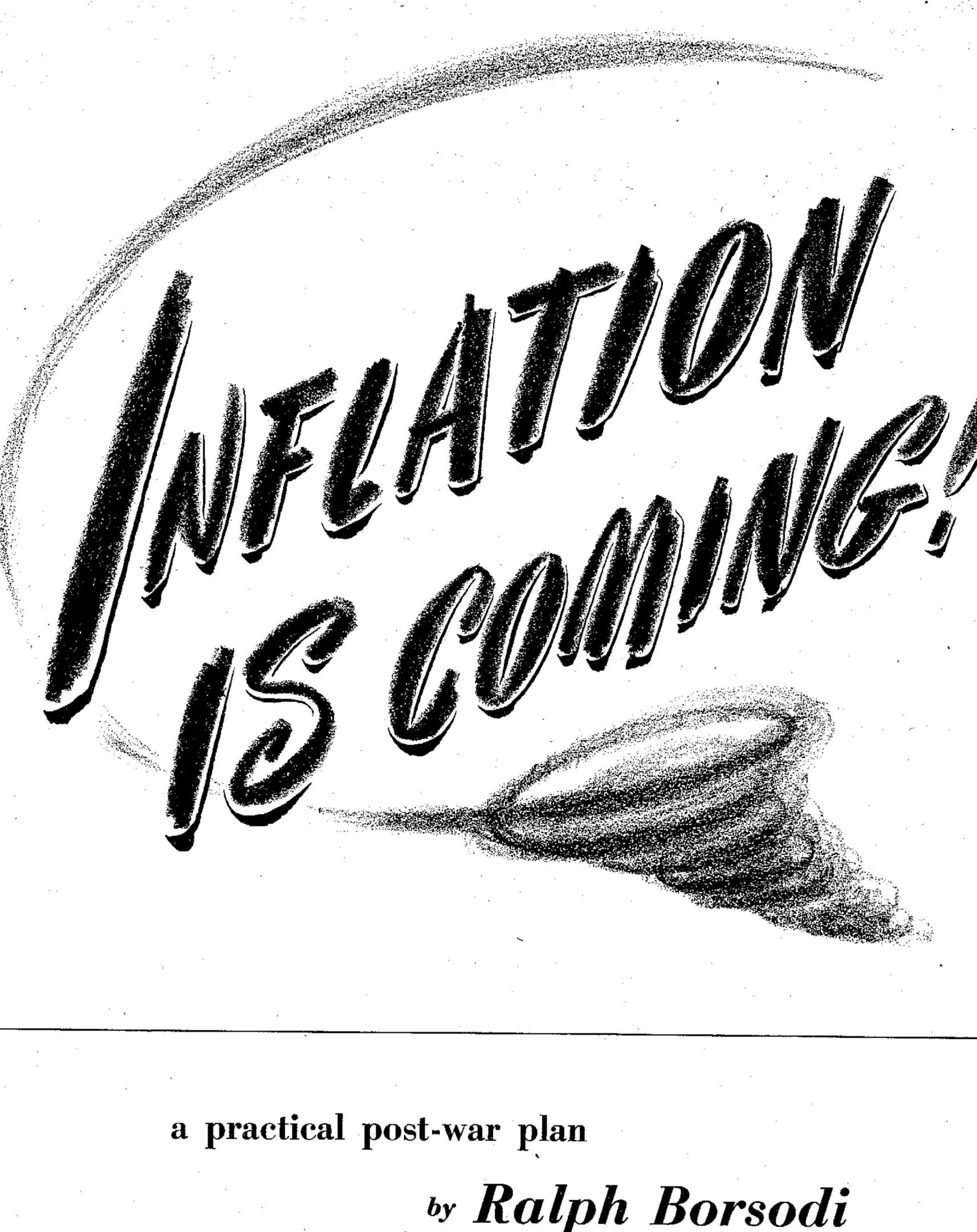
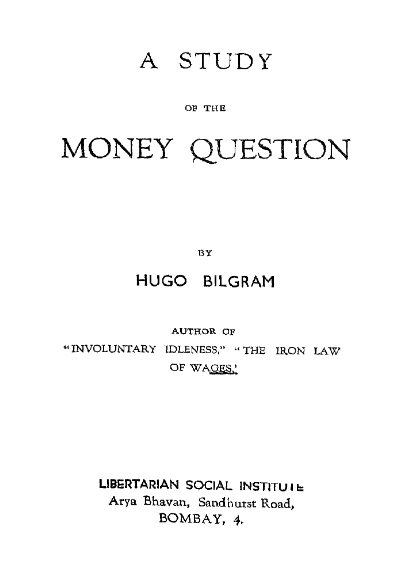
This post will be of particular interest both to monetary and economic researchers, and to practitioners. It describes my sizable and unique collection of books, pamphlets and other print materials, many of which are available in digital format, and announces a couple important additions, specifically, Ralph Borsodi’s, Inflation is Coming and What to Do About It, and, Hugo Bilgram’s, A Study of the Money Question.
____________________________ Finally, I have agreed to present at an Anti-authoritarian gathering in Switzerland on the 21st of July. I will most likely participate remotely to avoid depleting my strength with a long intercontinental journey. The gathering is billed as Anarchy 2023, but don’t be put off by that label. Oligarchs and despots have sullied the word “anarchy” by equating it with chaos, but the true meaning of the word “anarchy” is “without rulers,” it raises the question of the true locus of sovereignty and seeks the empowerment of people instead of kings, emperors, presidents and “representatives” that inevitably become repressive and tyrannical.
This post is adapted from a conversation I had with one of my followers in 2021. The questions that were posed are quite pertinent and wide ranging, and I think my answers will be of interest to anyone who wants to understand mutual credit clearing and/or is considering designing and implementing one.
1. At the least minimum, how many businesses should be there in the network to begin tradingwith each other and should we be thinking about a maximum limit, if yes, then why and how?
It is not only a matter of numbers but also of variety of goods and services represented and the volume of sales. Conceivably, a mutual credit clearing network could begin with a single large trusted business that would have a large line of credit in proportion to their monthly sales volume, say a debit limit of 2 or 3 times monthly sales. All other members would need to earn credits before they could spend credits, they would have no line of credit until they had demonstrated their earning capacity within the network. But it would be better in many ways to have a number of “trusted issuers” who offer a variety of goods and/or services that are in regular demand, and who thus qualify to receive a line of credit.
In practice, commercial trade exchanges do not launch until they have a few hundred members that offer diverse goods and services, but in each case, the line of credit (debit limit) must be proportionate to their capacity to provide desired goods and services.
2. What are the differences in benefits for an issuing member, non issuing member?
An issuing member has been given a line of credit; they can spend before they earn. A non-issuing member does not (initially) have a line of credit; they must earn credits before they can spend credits. As they demonstrate their capacity to sell as well as buy, they may then qualify for a line of credit.
3. How can a non member of the network be a part of it?
A non-member can join the network to buy from, and sell to, the other members. Also, a non-member can be brought into the process by accepting vouchers issued by the network, as follows: It a member wishes to buy something from a non-member, s/he might ask the network administration to create voucher notes or tokens which they can draw against their account balance or line of credit. Those vouchers can then be offered as payment to a non-member vendor for goods or services. If the non-member is willing to accept them, the vouchers could then circulate outside of the network, but the voucher must have an expiration date to assure that the credits they represent will be returned to the network ledger when they are used to buy something from a network member.
4. In India, we have a savings culture as most people are still conservative when it comes to their money and also because there are major future investments for parents and families because culturally they are responsible for getting their children educated and married both requiring a lot of money. In that context, won’t people be uncomfortable in having just a medium of exchange and not able to save the currency which is a general tendency.
Surely, people need to save, and there are many ways to do that already. Savings can take the form of real assets, like precious metals, collectibles, tools, equipment, land, buildings, machinery, etc., or financial assets like corporate shares, bonds, savings deposits at a bank, etc.
Those ways remain available and assets can be acquired with an alternative currency as well as with conventional currency from anyone willing to accept the alternative currency in exchange for those assets. In the early stages, it is more likely that an alternative currency will be accepted for real assets than for financial assets, most of which must be acquired from banks and other institutions that are part of the dominant fiat money system. As I’ve suggested in my books, as a credit clearing exchange develops it can add savings mechanisms to it exchange services. Those who have surplus credit balances can shift them to their “savings” account just as people do now by shifting balances from their checking account to their savings account at their bank or credit union.
5. When the network reaches different sizes of member businesses like 20, 50, 100, 500, 1000: In these instances, how should the credit allocation be thought about, will it change according to the size or the types of businesses in the network, how to decide what number of possible issuers can issue at one time meaning how to think about the maximum credit issuance in a network?
I’m not sure what you’re asking here. The overall amount of credit that exists within a network at any one time will adjust itself according to the amount needed to complete all desired trades so long as account balances remain within allowed limits. Each account will be evaluated individually to decide its debit limit by applying a standard algorithm that is based mainly upon the sales volume of that account but also may include other factors such as the type of goods and services it provides (essential necessities that are in constant demand, or not), reputation with customers and/or suppliers, overall indebtedness (and risk of insolvency), sales trends, etc.
It is expected that most account balances will remain well within allowable limits but still provide the members with adequate liquidity. Those that are chronically close to their limit will be assisted in finding new customers and sales possibilities and/or developing new products and services that are in demand.
6. In India, in the informal sector (which is minimum around 60%), a transaction happens either fully in cash or partly in cash (not shown in records for tax purposes) and partly cheque/ bank transfer/ net banking etc. What needs to be done in such a scenario?
Under the present circumstances, government policies are typically antagonistic towards small and micro-businesses, and support market dominance by large corporations. It is hard to fault anyone for trying to avoid tax liabilities by using paper cash and other anonymous payment options. But the evident recent trend has been toward the elimination of cash by governments. Governments and banks everywhere seem determined to force a shift of monetary and financial transactions onto channels that allow every transaction to be tracked, and upon which taxes and fees can be levied. Furthermore, the complete replacement of cash by such digital currency systems will further tighten government control over how you spend your money, or whether you will be allowed to access it at all.
Mutual credit clearing is not intended to be a means for avoiding taxes. Rather it is a way of providing an economy with liquidity (a means of payment) that is independent of the banking system and supplemental to the supply of political money. See my web post, There ain’t no such thing as a free lunch: Principles of Credit, Exchange, and Finance, especially Addendum 2.
It is crucial to personal freedom, the survival of small businesses, and to local self-determination that such independent payment systems be established and reach significant scale prior to the complete centralization of money power into the hands of the political, banking and corporate elite.
7. Also in our informal sector, we have a data problem because most businesses are not incorporated hence most of them don’t maintain balance sheets which are public and can be trustworthy (again one problem being that they don’t want to show their actual income in order to avoid high taxes), so in that case how do we as an exchange operator could trust the issuing members?
The crux of organizing a system to provide the exchange function is for actors in the economy, be they unincorporated businesses, corporations, or individuals, is in deciding whom or what to trust with a line of credit, and to what extent (how much credit). There are numerous factors that might be considered in deciding credit lines. Each commercial trade exchange has its own system for doing this. Here below is one example. I’m not saying that it is the “right” formula but it serves as an example of a few factors that might be considered. Of course, local circumstances must ultimately be considered in deciding which factors to include and how much weight should be given to each. In the circumstances you describe, reliance will likely need to be primarily upon the reputation a business has among its suppliers and customers, and estimates of business volume based on self-reporting and confirmed by observations. Along with establishing the mechanisms for facilitating the exchange of value, we need to be building communities based on face-to-face interactions and personal knowledge of those we are doing business with.
Recent scandals have show that even the audited balance sheets of public corporations may not be trustworthy.
8. With the issuing principle, you explain in what quantity a business should issue its currency, but just to be sure, does that factor in the sales the business will have in rupees/dollars because that depends completely on the market demand.
At the beginning of operations of a mutual credit clearing exchange, there will be no available data on the volume of sales within the exchange, so one must estimate that potential based upon a member’s sales volume in the rupee or dollar economy, AND the number and size of those exchange members who might be their customers.
9. Will the mutual credit achieve its vision if a transaction is done partly through mutual credits and the rest through fiat (This I think will help people adopt the system because that way they might save in their own currency too and feel safe about it). How should we view this whether part payments will take us to the vision or no?
What you are referring to is called in the commercial trade exchange industry a “blended trade.” This is generally allowed on large transactions but discouraged on smaller transactions. Yes, members may feel more comfortable with blended trades, considering that they need to be sure of covering their cash costs, but it is a departure from the ideal. While a business must cover cash costs overall, cash costs need not be covered on each and every transaction. I recommend that, except on very large transaction amounts, the cash portion should never exceed 50% of the transaction amount. Sardex has used a sliding scale for the percentage of cash allowed according to the size of the transaction.
10. You said to recruit all members of the supply chain till the basic commodity producers, but the supply chain is not just national but international so in that case it looks very difficult until we have credit exchanges all over the world. I understood pretty much I think your regional economic development plan but for so many of the products which just can’t be import replaced, how will the development plan work?
Yes, of course that is the problem; the entire supply chain is not entirely local or even national. But it is important to drill down into the supply chain as far as possible to maximize the amount of transactions that can be cleared. Further, sustainable economics and community independence require that more goods and services be sourced closer to home. The present global economy has extended international trade far beyond the amount that is necessary or desirable, has favoured mega-corporations and industrial agriculture, is dependent upon the subsides and other support provided by national governments and the banking system, is wasteful of energy required to transport goods long distances, and is, in real terms, unsustainable. The necessary transition back toward local production for local consumption requires “import substitution” which works in harmony with, and is stimulated by, the local control of credit and systems of mutual credit clearing.
We must begin with what is presently possible and build upon that. Ultimately, I envision the development of a global credit clearing network comprised of relatively small local nodes — an “internet of exchange” in which credit is locally controlled and managed, but globally useful for payments.
11. Since the taxes are collected by the central government, how will taxation be affected because the central government would never accept it?
Of course, taxes must be paid in whatever currency the government demands, so every member must make sure that they earn enough in that currency to do so.
12. Will the issuers of the currency have the entire line of credit at once in the beginning itself? Or will it be slowly increased?
No, a line of credit is simply a maximum amount that can be accessed, i.e., the limit on one’s debit balance. Trade Credits in a mutual credit clearing circle can be thought as an internal currency. That currency is created only when it is spent into circulation. Prior to that it does not exist; it is not on the ledger. That is also true for conventional money that banks create by making “loans,” but banks pretend that money is a thing so they charge interest on the entire amount of a “loan” even if it remains a deposit in the borrower’s account and never gets spent.
13. Can’t businesses which don’t have regular demand for their products issue currency?
Imagine such a business that does not have a regular demand for their products asking you to accept their private currency as payment for something you are selling. Would you accept it? Why? Would you be able to spend it? Where?
A currency is created when the issuer spends it. What gives a currency value is the issuer’s promise to accept it back as payment for something they sell. If no one wants what they sell, no one will want their currency; it will have no value to anyone. An issuer of a currency must be ready, willing, and able to redeem their currency, not by giving fiat money for it, but by delivering the goods or services they have to sell.
14. How will the network work if there are no issuers and hence no lines of credit for any business to begin with and let’s say there are 20 diverse businesses in that network, the money gets created the moment there’s a transaction between a buyer and a seller as debit and credit in the system and likewise further, what are the effects of it?
It can’t. Some businesses must be assigned lines of credit, i.e., they must be authorized to spend before they earn. The total of debits (or credits) in a clearing system are the “money supply” of the system. No credit; no money/currency.
15. Can the currency be created based on a specific problem a small business faces, e.g., working capital shortage, or increasing employees’ salaries or a specific sector for that matter?
A currency is intended to facilitate the exchange of goods and services; it must therefore be created on the basis of existing goods and available services. A currency thus monetizes working capital (inventories and accounts receivable). Capital improvements, on the other hand, should not be the basis for currency creation because the goods and services that they are intended to produce will not be available until some later time, if at all. Investments in capital improvements must be financed out of savings.
16. In the beginning, should every business get a positive credit allocation regardless if it’s an issuing or a non issuing business?
An issuing business is, by definition, one that qualifies for a line of credit. The qualifications for a line of credit have already been discussed. Please note that in assigning lines of credit there are no judgements being made about anyone’s “personal” worth, but only about the value of the goods and services they offer to sell and the potential demand for their goods and services in the market. The line of credit monetizes the value of those goods and services in the form of trade credits that can be used to make payments to others within the system. Have a look at my monograph that explains that further, Liquidity and Monetization. This monograph defines key terms in the design and issuance of exchange media.
17. Continuing on the supply chain example given earlier, let’s say if a business has 50 SKU’S, out of those, for 20 SKU’S, the suppliers are locally available so there are dealings done with them, but not for the remaining 30, in that case should he keep different numbers for different products? Same goes for products with different margins: How will the business set the credit amount for each product in that case?
An SKU is an identifier of a particular product. Your hypothetical example says that a particular business needs to inventory 50 different items, of which only 20 can be sourced locally. I see no reason why different SKU numbers would need to be used. Those items that are available locally can potentially be paid for using trade credits, while those that are not will continue to be bought using the government fiat currency. The margin on each SKU item is not relevant.
Regarding the second part of your question, I presume you are speaking here again of blended trades. The business will need to work that out based on their experience. As I said before, cash costs do not need to be covered for each individual transaction but must be covered in the aggregate. This leaves room for the business to decide the cash proportion on the basis of marketing and demand considerations as well as financial ones.
18. Is it really right for us to charge the transaction fee on their money? And I couldn’t understand the brokerage fees and other ways of monetizing the service? This question of the business model has me bothering since sometime now both from the ethical and the practical standpoint.
A trade exchange, like any other business, will continue for some time to have some expenses that require cash payment, e.g., for taxes and goods and services that are not available within the trade exchange. Like every other business, it must therefore generate some cash income. As trade exchange networks grow, a larger proportion of the administrative needs can be sourced from the membership using trade credits and the cash needs will decline, then most of the revenues can be collected in trade credits.
19. If a business accepts partially in mutual credit, will the businesses decide how much % that would be and keep fluctuating it according to their needs, and if so, how will it affect other businesses?
Each trade exchange has their own policies about blended trades and, as I mentioned above, there are competitive considerations to be taken into account as well as the overall benefits of the credit clearing services. Businesses should be allowed to vary the cash percentage according to their needs but within certain limits specified in the membership agreement. See my model membership agreement as a possible starting point.
The IRTA has, over the years, produced many policy recommendations for its member trade exchanges and many of its documents are available to the general public. I would recommend that you search their website.
20. You didn’t mention the maximum limit on numbers of businesses in one network?
That number will need to be determined in practice, with due regard to the need to maintain the personal aspect and high level of trust among the members in each local exchange circle (node), and the “Dunbar number” or “Rule of 150.” Here’s an excellent article that explores the question: Dunbar’s number: Why we can only maintain 150 relationships.
21. How will an issuing business actually ever know how much to issue because he will never know how much business is going to come through fiat money meaning how much inventory will he order?
An issuing member issues currency by buying from others in the circle, or in the wider network of circles. He is then committed to sell that same amount of value in return for the trade credits he issued. If trade credits are presented as payment he must accept them so long as he has credits outstanding (a negative balance on his account). He must have sufficient inventories to satisfy the total demand regardless of the form of payment tendered. Since his credit line was assigned on the basis of his likely sales, there should generally be no problem about his ability to deliver. Actual performance of each account must be monitored and action taken to prevent problems from developing.
22. How will the network adjust itself, as you mentioned in the document earlier? Are there real world examples on that?
I said the “volume of outstanding credit” will adjust itself. If there is very little buying and selling within the trade exchange then there will be very little credit on the books; as more trading occurs, more credits will (potentially) be created.
23. What do you mean by “businesses remaining well within allowable limits”?
Just what I said, “Each account will be evaluated individually to decide its debit limit by applying a standard algorithm that is based mainly upon the sales volume of that account but also may include other facts such as the type of goods and services it provides, reputation with customers and/or suppliers, overall indebtedness, sales trends, etc.”
24. What software platforms are available to use right away at low cost or even for free? How do i get started as quickly as possible with the software?
That depends upon the level of security you need. There are many proprietary programs available in the commercial trade exchange sector.
A few free options that I’m aware of include: Cyclos (https://www.cyclos.org/products/). Version 3 is open source and free, while version 4 is free to try and more functional.
Community Exchange Network (CES) (https://www.community-exchange.org/home/) is a platform that provides free hosting for hundreds of local currencies and exchange systems worldwide.
Community Forge (https://www.communityforge.net/en). “Community Forge is a non-profit organization that designs, develops and distributes tools around complementary currencies.”
25. What are brokerage fees?
Commercial trade exchanges typically employ brokers to assist users in finding both sales opportunities and ways to spend their trade credits. Usually, these services are included in the membership fees, but brokerage services may be billed separately.
26. Are there contextual factors you think should be understood before implementation?
Yes, launching a mutual credit exchange requires a lot of ground work in making contact with prospective participants, getting expressions of interest, and ultimately commitments to participate. It is helpful to work through established networks like business, social, cultural, and religious organizations. Publicity and news articles can help with recruitment and generation of a favorable attitude among the general community.
In this interview I provide a succinct description of the present central banking, interest-based, debt money system and its dysfunctional nature, the global crisis that it has created, and what we can do to transcend it.
Over the past few weeks I’ve begun the process of cataloging the books, pamphlets and other print materials in my unique and rather sizeable collection. The process has been greatly facilitated by using an app named CLZ Books which is able to find citations from the online database by reading the bar codes that are usually printed on the back cover or dust jacket of a book, or by manually entering the ISBN, or title, or author.
Many of the works in my collection are old enough to lack bar codes and many lack even ISBN numbers, but these can often be found in the database by manually entering the title or author. So far I’ve managed to catalog almost 200 titles. The remaining items are pamphlets and photocopies which will require more intensive effort.
In going through this process, I’m selecting a few works to add to the digital Library on my website Beyondmoney.net. I first do a search to see if digital versions already exist somewhere on the Web. If they do, I’ll provide a link, or download them to my computer and place them on my own website. If no digital version is found, I may choose to transcribe the work, either in whole or in part, by speaking it into a voice recognition app that is able to convert it to text. An example of the former is Inflation is Coming and What to Do About It, by Ralph Borsodi, one of the people who have inspired my work. It was written in 1945, but the copy I have in my library is the 1948 version which is essentially the same. I did retrieve a PDF file of the book from the website of Cooperative Individualism, and you can read it here.
The financial and economic collapse did not happen as soon as Borsodi thought it might, nor did it quite follow the mechanism that he expected. He seems not to have anticipated the globalization of the economy, the shift of the US from the world’s greatest creditor nation to its greatest debtor, or the extent to which the US dollar would become the global reserve currency, and the enormous appetite of other countries for holding and accumulating ever greater pools of dollars. Neither did he foresee the long succession of stop-gap measures that have been rolled out by the political and monetary authorities over the subsequent decades to prop up the flawed system, such as corporate and bank bail-outs, corporate consolidations, quantitative easing, and bail-ins, and the ever greater centralization of financial, economic and political control. But Borsodi was not wrong. We can now see looming on the horizon either (1) the collapse the dollar and the global financial system, which will take the economy with it, or (2) the imposition of an ever more totalitarian government that will micro-manage every aspect of society and individual behavior.
The first of these will probably be inadvertent and unanticipated. The second has long been planned, is in the works, and is rapidly unfolding. The global power elite seem to believe that they can engineer a controlled demolition of the existing financial mechanisms and replace it with a new system that will further increase their power and wealth. Recent developments are signaling the elimination of cash money, the introduction of Central Bank Digital Currencies (CBDCs), as well as onerous demands on people in the name of public health, climate change, and other “emergencies.” We should expect to see the United States and other countries to roll out their own versions of China’s social credit system which will determine what each individual will be allowed or not allowed to do, along with some system of positive personal identification (PPI), most likely using a mandatory chip implant.
My physical book library also contains a rare copy of, A Study of the Money Question, by Hugo Bilgram. This slim volume,
published in 1894, provides some valuable insights into the essential nature of money, the necessary functions of an effective system of exchange, a critique of the banking system as it existed at the time, and Bilgram’s description of a “rational money system.” I did not expect to find it on the web so I spent a considerable amount of time transcribing it and adding my commentary, which you can read here. A subsequent search did locate a PDF file of the book on Internet Archive, which I have downloaded and added to my online Library.
I believe that both of these will be of value to serious students, researchers and innovators working in the field of money, banking, and exchange.
In this isssue I describe what private currency vouchers are and how they can help solve the money problem that I’ve been writing about for the past 35 years. Here’s the full table of contents:
Private Currency Vouchers, an Answer to the Money Problem
History and current events
Other Historical Documentaries
Taming the corporate beast
It is 90 seconds to midnight
Pasta with broccoli
You can read the entire newsletter here or here. Subscribe to receive my future occasional newsletters. ____________________
Unlike, government and central bank fiat currencies which promise nothing but their acceptance as tax payments, private currency vouchers promise to be redeemed for real valuable goods and services. If the issuer is trustworthy and can be counted on to honor their pledge of redemption, their currency vouchers can provide traders with an exchange and payment medium that is superior to government and central bank fiat monies. Such honest currencies are neither novel nor odd, but have a long history and are an absolute necessity for the decentralization of economic and political power and the emergence of a peaceful and equitable social order.
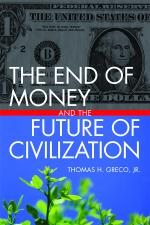
So what sorts of entities can be trusted to keep their promises, how do they put their currencies into circulation, are such currencies legal, have such currencies ever been issued before? In brief, a currency voucher is spent into circulation when the issuer offers it as payment to a supplier, employee or a creditor, who accepts it as such. In the United States and most other “free” countries, private currency vouchers are entirely legal and there are numerous historical instances of their issuance and circulation. These questions and many other details have been fully answered over the years in my various writings and presentations, most of which have been posted or linked on my website, https://beyondmoney.net/. Particularly relevant are my book, The End of Money and the Future of Civilization, as well as my 2021 presentation, Transcending the present political money system–the urgent need and the way to do it, and my 2021 webinar series, Our Money System – What’s Wrong with it and How to Fix it.
A few years ago I wrote up a proposal for a private currency voucher that I call the Solar Dollar which attracted some significant interest. My intention was twofold, one, to provide an independent payment medium for a local community, i.e., a currency that can be created outside of the banking system and thus empower participants in a local economy by compensating for shortages and mal-distribution of government fiat money, and two, to incentivize the shift of energy production, sales and usage toward solar and other renewable sources of electric power. My hope was that some electric utility company somewhere would implement the plan and become a model for others utilities to follow. That, unfortunately, has not yet happened but I am confident that it, or something like it, eventually will. In the meantime, I’ve continued to publicize it, and in 2021 I was invited to give a presentation titled, Solar Dollars–Empowering Communities While Powering Communities With Renewable Energy, for a virtual conference that was sponsored by the Zero Carbon Lab at the University of Hertfordshire (UK). Later that year, under the good auspices of Professor Ljubomir Jankovic, my original white paper was revised and published with the title, Solar Dollars: A Complementary Currency that Incentivizes Renewable Energy, in the academic journal, Frontiers in Built Environment.
Overall, the primary objective of my work has been, and remains, the decentralization of financial, economic, and political power. The most promising strategy for achieving that is the design and deployment of private credit currencies that are spent into circulation by trusted issuers that are ready, willing, and able to redeem their currencies promptly for the real goods and services that are their normal stock in trade. By breaking the credit monopoly that the banking cartel presently holds, and empowering producers and sellers of real value, it then becomes possible to reverse the longstanding trend toward ever greater power and wealth in the hands of the global elite who have captured the machinery of finance, economics, and government.
The Solar Dollar is a special case and example of a private credit currency issued by a trusted producer and provider of real value, but similar objectives could be achieved by companies in other lines of business, for example, by:
The issuance of local Farm Produce Dollars that would be spent into circulation by a single local farmer or jointly by a cooperating group of local farmers and ranchers, or by
The issuance of local Shelter Certificates that are spent into circulation by a single local owner of rental property or jointly by a cooperating group of local owners of rental property, or by
The issuance of Service Certificates by a local provider of some sort of professional or household services, or jointly by a cooperating group of such service providers, or by
The issuance of currency vouchers by all of the above producers/providers and others who band together to cooperatively issue a sound complementary currency under a common “brand.” Such a currency would provide a means of payment that is not only independent of the banking system but solidly backed by the combined production and distribution capacity of all participating businesses. (Many “community currencies” have been created over the years in many places around the world but virtually all of them are “sold” for government fiat currencies which defeats the main objective of creating a currency that is independent of government and the banking system).
All of these currency vouchers or credits are able to circulate as payment media throughout their local communities to enable trading despite any scarcity or unavailability of official money. There are many historical and contemporary examples of such private credit instruments, so most of what I’m suggesting has already been shown to be workable. The main problem I have observed is getting producers of real value to recognize the power they already have and to exercise it on their own behalf and that of their communities.
“The stream of political monies from the beginning to the present day runs deep and dirty, yet to suggest that money can spring from any other source is to surprise if not even to dismay. So has tradition dulled men’s senses. No matter how often the state fails to supply a virtuous money system, men rush back to it in desperation and beg it to try again. Indeed, until we learn that the money power resides in us, we must abjectly beg the state to give us an exploitative system because we cannot return to a moneyless civilization. Yet, no matter how often and earnestly the state tries to provide a true money system, it must fail because of an inherent antipathy between the money issuing power and the taxing power. A money issuer must be a seller who bids for money, not a taxer who requisitions it in whole or in part, as politically expedient and without a quid pro quid.” — pp. 25-26.
Political democracy cannot work without economic democracy; and the money power is the franchise of the latter. — p. 35
It is the false concept of political money power that converts citizens into petitioners, and makes government a dispenser of patronage instead of a public servant. This power of patronage utterly destroys the democratic system of government – since the people cannot be both petitioners and rulers.” — pp. 78-79
Throughout my career as a monetary theorist, educator, and advisor, taking up where Riegel and others have left off, I have tried to influence producers, entrepreneurs, and social organizers toward effective action based on sound principles of credit allocation and management. But superstitious myths die hard and old habits are difficult to break. The great majority of people remain in thrall to official currencies. That is what the oligarchs depend upon to keep us in debt and under their control. I have learned to be patient and await the changes in financial, economic, and political conditions that will open people’s minds to adopting self-help and cooperative approaches to getting our needs met, specifically, the need for free and fair exchange of value in the marketplace.
Surely, the day will come, and is rapidly approaching, when the failures and demands of the dominant global central banking, political, interest-based, debt-money regime will become so clearly evident and abysmal that the only peaceful option will be for we-the-people to implement our own systems of exchange and finance grounded in our own initiative and judgment in allocating credit based on productive capacity and trustworthiness.
Issuance, circulation and redemption of Private Currency Vouchers
Last year (2021) I gave a three part webinar presentation for The Henry George School of Social Science. In case you missed it, here is the description and the link to the recorded sessions. For each part you will find a list of recommended resources and references.
A critical look at the present global system of money and banking, how it has evolved, why it is problematic, and where it is trending.
The series will also look into past, present, and future exchange and payment alternatives, like Depression-era script, local and private currencies, commercial trade exchanges and LETS systems that apply the “credit clearing” process, and the more recent emergence of crypto-currencies and blockchain ledgers and their potential role. It will include discussion of how these have evolved, their advantages, limitations and future potential and what needs to be done to take them to scale, their political and economic implications, and innovations that are making conventional money obsolete.
WHAT is money?
WHY do we need money?
WHAT is wrong with our money system?
Can we live without money?
HOW can business be conducted without money?
What are the economic, social and political implications of monetary policies and systems?
What is the likely impact of present day monetary innovations?
May 21 – Session 1 provided an overview of the present system of money and banking, how it has evolved, how and why it is problematic, and where it is trending. I spoke about the interest-based debt-money system, how it causes the growth imperative and the politicization of finance and exchange, and the political and economic consequences of its continuation. I outlined the fundamental concepts of exchange and finance and the principles upon which sound and sustainable systems are being developed. Participants were asked to read or listen to some specific materials in preparation of the subsequent sessions.
June 4 – Session 2 was more interactive and provided ample opportunity to discuss questions that were evoked by the previous session and the assignments, including topics like inflation, depressions, asset bubbles and busts, the savings and investment functions, and government responses to shocks like the 2008 financial crisis and the more recent pandemic. This lead into discussion about possible solutions to the problems caused by the present system, and the role of local currencies and other alternatives for the exchange of value.
June 18 – Session 3 concentrated on past, present, and future exchange and payment alternatives, like Depression-era scrip, local and private currencies, commercial trade exchanges and LETS systems that apply the “credit clearing” process, and the more recent emergence of crypto-currencies and blockchain ledgers and their potential role. It included discussion of how these have evolved, their advantages, limitations and future potential and what needs to be done to take them to scale.
To round out your education you can also read my recent articles.
My Upcoming Presentation: Private and complementary currency systems
My Latest Article
There once was a river …an allegorical tale of money and credit
Will 2023 Be the Year from Hell?
Central Bank Digital Currency, a the Totalitarian Nightmare
The Legacy and Vision of Dee Hock (b. March 21, 1929 – d. July 16, 2022)
I had occasion to meet Dee Hock in September of 1995 when we were both invited to participate in the first of a series of symposia titled Peace Building for the 21st Century, a semi-annual gathering that was jointly organized by the Institute of Noetic Sciences, the World Business Academy, and Pathways to Peace and convened at the Fetzer Institute in Michigan. When prior to the meeting I read that Hock was CEO of VISA International, a rather lofty position in the world of conventional banking, I wondered how his beliefs and objectives about money and exchange could possibly find any agreement with my own. I soon discovered that my pre-judgments about him could not have been more wrong. During the symposium he impressed me as being a man of integrity and vision, and more a “monkish” philosopher than a banker.
That impression was strongly reinforced when in 1999 I read Hock’s newly published book, Birth of the Chaordic Age (later republished as One From Many), which told his personal story along with the story of how the VISA organization came into being and became “the largest commercial enterprise on earth.” To give you a sense of what captivated me I will share just a few quotes from the book. In the prolog, Hock said, “We are experiencing and epidemic of institutional failure that knows no bounds,” and, “The organization of the future will be the embodiment of community based on shared purpose calling to the higher aspirations of the people.” Such an observation and expectation were quite remarkable and unexpected but consistent with my own observations and aspirations. Then, on the back of the dust cover I read, “We are at that very point in time when a 400-year- old age is dying and another is struggling to be born–a shifting of culture, science, society and institutions enormously greater than the world has ever experienced. Ahead, the possibility of regeneration of individuality, liberty, community, and ethics such as the world has never known, and a harmony with nature, with one another, and with the divine intelligence, such as the world has always dreamed.”
Such ideas could not have resonated more closely with my own, and as I delved further into the book I was delighted to find a great deal more of that sort of visionary, humane, and wise thinking and expression. I took some time to ponder all of that as I went about my own work trying to move forward toward the development and implementation of innovative systems of exchange and finance that would embody the values and aspirations that Hock and I seemed to share. Then, in January of 2001, I wrote to Hock and was pleased when he responded a couple weeks later. Rather than try to excerpt the essence of each letter, I think it appropriate to present each in its entirety (I don’t think Dee would mind).
Dear Dee,
I’ve been meaning to write you ever since I finished reading your book almost a year ago. I guess my procrastination is due to the fact that I was not, until now, clear about what I wanted to say to you, or how to say it so you would take it seriously.
Certainly, praise is due. The Birth of the Chaordic Age is a masterful story, but, of course, it is more than a story, it is a philosophical treatise – and a work of art, studded with gems of wisdom. (In that, your monkish, contemplative bent is evident). I’m most grateful to you for seeking out these gems and fetching them back for us to admire and use. I especially like your four ways of looking at things – how they were, how they are, how they might become, and how they ought to be. It serves me well in the research I’ve been doing, and serves to remind me of why I’m doing it.
I am in full agreement with the testimony of your vision which appears on the back of the dust cover. I believe that, in the present era, the thing that is “trying to happen” (as Willis used to put it) is a fundamental shift from elite rule (command and control) to a more participatory, democratic, inclusive, just, equitable, and sustainable order. This means that, in addition to our own spiritual and interpersonal work, there is a need for thoroughgoing restructuring of our institutions and the emergence of networks and communities which will supplant limited liability corporations and much of the government bureaucracy.
As I approach my 65th birthday, I have a sense that my most important work is yet to be done. Despite your great accomplishments, I have a sense that that may be the case for you as well. Of particular relevance for me is the area of money, banking, and finance. This is where I think I can make a major contribution, and this is what I want you to know.
You have the distinction of having been the leader who guided the development of the world’s first global payment system. Yet, you express dissatisfaction with the outcome. It doesn’t satisfy me either. You say (on page 193),
“I could think of no way to fully realize the concept by including merchants and cardholders as owner-members. The slightest hint in that direction raised a storm of opposition. We should have included them. Perhaps, with more time, tenacity, and ingenuity we could have.”
Well, storms of opposition should be expected when those in control are asked to share power. The bankers have been a privileged class for a long time. Why should they give up such a powerful and lucrative position? There is only ever one compelling reason – because they can see that it is in their best interests to do so, and they have the courage to let go. Are you ready to show them the economic “magna carta?”
For the good of the people and the planet, the monetary system must be changed and economic power must be more widely dispersed. The key lies in the payment system. There is plenty of ingenuity being applied to the “money problem” within the current grassroots transformational movement, within the commercial “barter” business, and within the realm of emerging internet commerce. Proper leadership can draw out sufficient tenacity. And, time? Well, “carpe diem.” “The future is not about logic or reason. It’s about imagination, hope, and belief.” (p. 152).
Can you envision a federation of credit-clearing circles which include everyone who wants to be a member? Which is democratically organized and operated? Which allows each person the power to monetize some of their own resources and productive potential without having to pay interest to anyone?
It is my hope to assist in launching such a system. I believe that it is possible to assemble, right now, sufficient talent, resources, and commitment to get the job done. This could be your prototype socio-economic chaord which would demonstrate to everyone the kind of model needed for 21st century organizing.
I have no illusions about the willingness of bankers’ to accept such systems right now, but I must do what I can to harmonize how things might become, with how they ought to be. If we can create the seed crystal, the rest will take care of itself.
What do you say?
Tom Greco
About two weeks later I received this reply:
Dear Tom:
Thank you for your most kind, thoughtful letter. Indeed, people in position of privilege and power cannot be expected to surrender it to others, especially when no better alternative has emerged which the public trusts and demands, which captures the imagination of the powerful and privileged, ameliorates their fears, and which is allows them to make an orderly, safe transition. Power is never given, it is always taken. How to take it without destructive confrontation and brute force is the perpetual problem. In my view, that can only be done by creating new concepts which do not attack and destroy the old, but transcend and enfold them.
There is no doubt in my mind that more than enough intelligence, communication capacity and experimentation has already emerged to allow such new concepts to be devised and implemented. However, to transcend and enfold a system that is already global, ubiquitous, deeply entrenched in all societies and organizations and embedded in the consciousness of the whole world is not something that can be done by any one person, or even a narrow segment of them. Nor do I have any illusions about the desperate need for better means of exchanging value among all people. We have had much contact over the years with many people in emerging systems of barter, local currency, internet commerce and alternate currencies – Bernard Lietaer, Hazel Henderson, James Fierro and a host of others.
One of the concepts we think will take shape within the Terra Civitas movement is something we call, for want of a better term, the “resource commons,” a coming together of people with financial expertise of all kinds, new and old, to reconceive and bring into being new concepts of organizations and instruments that “result in more equitable distribution of power and wealth, improved health and greater compatibility with the human spirit and biosphere.” That is, I think, precisely what you refer to, albeit in other terms.
We are simply overwhelmed with response to chaordic concepts. Opportunities to create such organizations in various fields already exceeds our present resources and capacity. This is not something we can, at the moment, call into being. The initial interest and impetus would have to emerge elsewhere. We might act as a catalyst, a “strange attractor,” to put in terms of complexity theory and would gladly lend what legitimacy and expertise we could.
I have no doubt that with sufficient commitment from a design team of the right thirty or forty people and a hundred or two others to critique the work and reasonable resources, a “chaordic, fractaled organization” for the purposes you envision could be conceived, perhaps even implemented, before the end of 2002.
Again, many thanks for your thoughtful letter and kind comments about the book. With all best wishes,
Dee
Of course, 2002 came and went and twenty years later we are still seeking allies, supporters and resources, and wondering what else it will take to make this grand vision a reality, but surely its time will eventually come. That is not to say that progress has not been made. Promising innovations and improvements in exchange processes and moneyless payments have been made in both the grassroots and commercial “barter” realms, and I continue to work with several of those groups and individuals.
Numerous Dee Hock obituaries have been published online including the VISA website and Market Watch, and you can glean much more of his wisdom from Dee Hock’s webpage which is still accessible.
____________ My upcoming presentation
I’ve been invited to be a keynote speaker at the 6th Biennial RAMICS International Congress in Bulgaria, October 27 to 29. RAMICS is the Research Association on Monetary Innovation and Community and Complementary Currency Systems which includes both academics and practitioners.
My illustrated presentation titled, Private and complementary currency systems: purposes, principles, practices, and performance, is slated for Thursday, October 27. It will summarize what I have learned over more than forty years of research and experimentation in this field, and describe what must be done to realize the full potential of decentralized private and community exchange mechanisms. You can see the full abstract here. For various reasons, I am planning to deliver my presentation remotely from Arizona. This congress promises to be exciting and productive, and if you wish to participate you can find program details here and register at https://ramics2022sofia.sciencesconf.org/registration. ____________ My Latest Article My latest article, The Money Economy Is Not the Real Economy: “The Global Banking and Financial System is Fatally Flawed,” was published last week by Global Research, and recently republished on Medium. ____________ There once was a river …an allegorical tale of money and credit One of my most popular posts has been, There once was a river …an allegorical tale of money and credit. If you missed it when I first published it, you may want to check it out. I’ve used metaphor to try to show how we have all become slaves to money and those who control money. Using water to represent money, I’ve also tried to show that we the people can free ourselves and take back control by thinking outside the box to end our fixation on political fiat money, and deploy better ways of enabling the exchange of real value that our own labor and creativity produce.
Every metaphor, of course, is limited but I am hoping that readers/listeners will come to understand that there are alternatives to conventional money that we can use to reduce, and eventually eliminate our dependence upon conventional political fiat money. Credit is the foundation of an honest system of exchange and we have the power to give credit to each other in accordance with our own values and objectives, outside of conventional banks and without charging interest. You can access the story on my website (audio with transcript) or on YouTube (audio only).
____________ Will 2023 Be the Year from Hell? Noted economic forecaster, Martin Armstrong, says it will and makes a very convincing case in this interview on Greg Hunter’s USA Watchdog podcast; and it is very instructive to see the remarkable story of Armstrong and his work in the documentary movie, “The Forecaster,” if you can get hold of it. Amazon.com says “This video is currently unavailable to watch in your location,” but you can watch the trailer on IMDb and buy the DVD here. The movie includes the story about the persecution he suffered at the hands of the US government, being imprisoned for 7 years without a trial, and eventually forced to plead guilty to regain his freedom.
____________ Central Bank Digital Currency, a the Totalitarian Nightmare
If that isn’t enough to get your attention and stir you to action, this article, Just Say No to CBDCs, by N.S. Lyons clearly describes the nightmare world the technocratic oligarchy has prepared for us and will very shortly pressure us to accept. Some difficult choices are in prospect.
____________ Despite the gloom and doom that these present circumstances portend, I believe humanity has never been in a better position to create a world of peace, freedom, and conviviality. As Mahatma Gandhi said, “When the people lead, the leaders will follow.”
Thomas
____________ Permission to reprint contents from this newsletter in whole or in part is granted on the condition that full credit is given and a link to the original source is provided. – t.h.g. To forward this newsletter to a friend you can send them this link or the link to it on MailChimp where yiu can also subscribe to future newsletters.
I’m a little late in posting this here, but if you didn’t see it when I first sent it out, I think you will find it interesting and useful.
2022 June Newsletter ― Reconnecting the Monetary Economy to the Real Economy
In this issue:
Reconnecting the Monetary Economy to the Real Economy The Banker’s Last Gasp and the Great Monetary Reset The Usury Conjecture on the centralized, interest-based, debt-money system What about China? Is this a clear picture of the New World Order? Take responsibility Food security Friendly, kind, and generous
If you want keep tabs on what I’m been thinking, feeling, and doing, you can follow me on twitter (tomazgreco), or Facebook (thomas.h.greco), or follow my blog at https://beyondmoney.net/. _____________
Reconnecting the Monetary Economy to the Real Economy
Money is the “hole” that is defined by the “doughnut” of real goods and services; it is the nothing that serves only to account for that which is available in the real economy. When pseudo-money can be created by fiat, apart from anything of real value, confusion and madness ensue. — T. H. Greco, Jr.
I’ve been arguing for more than 40 years that the global system of money, banking, and finance is fatally flawed, and now its condition has become acute. Since 2008 it has been on life support. The connections between the monetary economy and the real economy have long been tenuous, but in recent years have been severed to the point of non-existence. When banks and governments can create quasi-money out of nothing without any real value basis and allocate it selectively to advance political agendas, you know the end is near. The last vestiges of budgetary restraint on federal government spending have been eliminated along with any concern about what people really need and want. The results have been the ever-increasing centralization of power at the federal level, central planning of the economy, worsening price inflation, declining purchasing power of fiat money, increasing corporate ownership of real assets, especially residential real estate, zero or negative returns on people’s savings, and increasing disparities of income and wealth. The only way this system can be perpetuated is by the complete elimination of any semblance of democratic government. As E. C. Riegel observed almost 80 years ago: “Society is in the twilight of a passing day. The state now undertakes to finance the economy, and, since a free economy is manifestly impossible where the state assumes the responsibility of supplying the money circulation, the politician is compelled to choose between fascism and communism.” – Private Enterprise Money
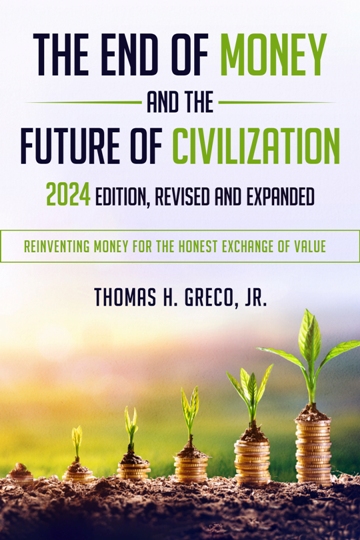
The first edition of my book, The End of Money and the Future of Civilization, was published by Chelsea Green Publishing in 2009. While it remains as relevant today as it was when first published the printed book has been out of print for several years. But, having had the rights reverted to me by my publisher, I am making the entire book available for free in PDF format. You can read it or download it HERE. If you would like a hard copy of the first edition used copies can still be found on Amazon.com, Abe books, Thrift books and elsewhere.
Better still, you can avail yourself of the new revised and expanded 2024 edition which I have been working on for almost two years and is almost complete. Eighteen chapters have already been posted and can be freely read or download HERE.
My previous books, as published, may be freely accessed in digital format by clicking the title below.






 Beyond Money