I’ve added a new monograph on the subject of demurrage to this site. You’ll find it in the sidebar to the right under Resources: Monographs: Demurrage: is it a good idea for a local currency or exchange system?
Or click here.

I’ve added a new monograph on the subject of demurrage to this site. You’ll find it in the sidebar to the right under Resources: Monographs: Demurrage: is it a good idea for a local currency or exchange system?
Or click here.
Posted in Developing Alternatives, Exchange Design, Prescriptions
Tagged credit clearing, demurrage, exchange, investment, saving, Silvio Gesell, stamp scrip
Here’s an inspiring talk by Cameron Herold on ways to become more self-reliant and less dependent on government programs. Couple that with sharing, cooperation, and community organizing and maybe we have a formula for creating the “butterfly economy.” — t.h.g.
Posted in Developing Alternatives, Emerging paradigm, Prescriptions
Tagged community, cooperation, entrepreneurship, self-reliance
The US dollar is being inflated at an unprecedented rate. Dollars are being created on an improper basis, mainly by monetization of the government’s budget deficits, in order to bail out financial institutions and companies deemed “too big to fail.” While small businesses and workers are being made to suffer, dollars are being lavished on the military-industrial-financial sector. With dollar inflation, the general level of prices will eventually increase, the dollar will lose much of its purchasing power and dollar denominated investments will become worth less in terms of goods and services.
The big question is, how can savers protect themselves from the adverse effects of inflation? How can middle-class people protect their small nest-egg savings and avoid seeing it shrink in purchasing power?
One can either invest in something that will command a higher price as the value of the dollar shrinks, or one can acquire investments that are denominated in some more stable unit. There are many historical examples of hyper-inflation of national currencies and citizens’ responses to them. One example I’ve written about in my book, The End of Money, is the German hyper-inflation of 1921-23. Another is the current inflation of the currency in Zimbabwe.
In that book and in my previous books, I’ve proposed the adoption of an objective measure of value based on an assortment of basic commodities. Another option is to define a more stable measure of value and pricing unit based on existing government statistics. One such example of the latter is the Chilean Unidad de Fomento (UF), which is a pricing unit based on the Chilean Consumer Price Index. Here is the description of UF from Wikipedia.
The Unidad de Fomento (UF) is a Unit of account that is used in Chile. The exchange rate between the UF and the Chilean peso is constantly adjusted to inflation so that the value of the Unidad de Fomento remains constant. It was created on January 20, 1967, for the use in determining principal and interest in international secured loans for development, subject to revaluation according to the variations of inflation. Afterwards it was extended to all types of bank loans, private or special financing, purchases or investments on installments, contracts, and some special situations. Also it is used in legal standards such as the par value of stock/capitalization of companies, fines, etc. It has become the preferred and predominant measure for determining the cost of construction, values of housing and any secured loan, either private or of the Chilean government. Individual payments are made in Chilean pesos (the country’s legal tender), according to the daily value of the UF.
The main drawback of using government statistics as the basis for a value unit is the fact that they are subject to political influence and manipulation. The U.S. CPI, for example, greatly understates the true cost of living. This is strongly argued by Chris Martenson in his Crash Course.
Better than nothing, perhaps, but not really good enough to forestall a wipe-out of the middle class. We need an independently defined measure of value. I’ve described how to construct such a measure; what remains is to choose the specific commodities and the markets in which they are traded, to give that unit a name and to publish it.
James Robertson and I have known each other for many years and I think there is a great deal mutual respect between us. James is quite insightful and his heart is in the right place, and that is reflected in his latest newsletter, part of which I’ve included below. Our main point of disagreement is about what changes are necessary to deal with civilizations current crisis and what might be fruitful approaches to making them. (1) He, like most Brits and Europeans I’ve encountered, still believes in statist solutions. They think they have a chance to influence, if not control, the political process using the existing structures. (2) James also believes that central government should be the provider of exchange media (money). On the first of those, I believe that the nation state has outlived its usefulness, that power has become over-centralized and therefore corrupting and corrupted, and that decentralization and human-scale must be the order of the day. On the second point, I believe in the need for government to relinquish the money power and to repeal legal tender laws that give one brand of money a monopoly and force its acceptance even though it is inevitably abused by improper issuance and misallocation. I address this in the chapter titled “The Separation of Money and State” in my latest book, The End of Money and The Future of Civilization. In 2002 I wrote an appraisal and critique of the proposal that he and Josef Huber published in 2001 under the title Creating New Money: A Monetary Reform for the Information Age. That critique can be found at http://reinventingmoney.com/monetary-reform-information-age/ . James’ review of my book, can be found at http://www.jamesrobertson.com/news-jun09.htm#greco. Subscriptions to his newsletter are free; you can sign up here. — t.h.g. James Robertson Newsletter No. 28 – January 2010 1. EDITORIAL: THE TRANSITION TO A NEW DECADE The ‘Noughties’ have shown that we in the “democratic West”, led by a global super-power in the USA, can no longer claim a specially democratic and influential position in world affairs. The claim to be democratic has been disastrously damaged by our self-imposed dependence on profit-making commercial banks to provide our public money supply, by our elected representatives’ money-grubbing, and by the way the US and Britain invaded Iraq and destabilised the Middle East. The claim to be influential has been shown up at the recent Copenhagen conference on climate change, when the newly powerful nations, led by China and supported by many “less developed” peoples, insisted that their future development prospects should not suffer from the need to repair the global ecological damage caused by Western development over the past 200 years, and that we should bear the main cost of repairing it. In Britain we face a general election within the next six months. There is a widespread sense that none of our mainstream political parties is capable of responding effectively to the range of national and international challenges we now face. If their election campaigns confirm this, the result could be a temporary “hung Parliament”. We electors and our politicians might then recognise the need for deeper-seated changes than mainstream agendas now offer. A two-year transition to the ‘Teenies’ decade could then see the start of a deliberate shift to a new worldwide path of co-operative development and democratic participation. It would give us a much better chance of securing the future of our and other endangered species, than trying to restore competitive Business-As-Usual. 2. MONEY SYSTEM REFORM A major aspect of that new path of development has to be a money system fit for its purpose. 2.1. The Purpose of the Money System The money system’s purpose must change from what it has been since its origins in the distant past. It must no longer be designed to provide a stealthy way to transfer wealth from weaker and poorer people to richer and more powerful ones. (If you don’t believe that this is a fair description, take a look at my short History Of Money –www.jamesrobertson.com/books.htm#history). Its new public purpose now must be to enable everyone to benefit from fair and efficient exchanges of goods and services, reflecting what we each contribute to and take from the common wealth. It is a purpose for which governmental agencies at local, national and international level must become directly responsible. To get the money system reconstructed for this new purpose, we have to understand it as a system of interacting money subsystems which influences our behaviour at every level – personal, household, local, national, and global. We have to understand how it generates a calculus of values, and how that operates as a scoring system motivating us by rewarding some things and penalising others. And we have to understand how its present modes of operation motivate us to behave in ways that hasten our species’ suicide. The following four governmental decisions primarily determine how the money system works – in other words, what values it generates in terms of the prices and costs of everything compared with everything else, and so how it motivates us to behave:
Today, all of those urgently need systemic understanding and reform. The full Newsletter can also be viewed here.
Posted in Geo-politics, Prescriptions, The Political Money System
During the Economics of Peace conference last October I gave a presentation titled, The Economics of Peace Justice and Sustainability. The video of that presentation is now available in three parts for viewing online at: http://vimeo.com/channels/theeconomicsofpeace/page:4. In the near future, I plan to add to this blog the slide graphics that accompanied my presentation.
Posted in Basic Concepts, My activities, Prescriptions, The Political Money System
Tagged credit clearing, Economics, Federal Reserve, Greco, peace, sustainabily
Here are some segments of an interview I had with Daniel Pinchbeck during the Economics of Peace Conference in Sonoma, California in October of 2009. This interview was recorded by Haig Varjabedian
You can watch the entire interview in four parts on Vimeo.
Daniel Pinchbeck is an author and the founder of RealitySandwich.com, a website forum regarding experiences and initiatives surrounding the evolution of consciousness.
I also did an interview with Regina Meredith of Conscious Media Network.
Posted in Basic Concepts, Developing Alternatives, Prescriptions, The Political Money System
Tagged bailout, Banking, credit clearing, Greco, inflation, interest, meltdown, money, Pinchbeck
Richard C. Cook had posted a new article titled,
The Economic Crisis and What Must be Done
In it, he provides an excellent summary of our current situation and how we arrived at it, along with some concrete proposals.
On the legislative front, he call for Congress to pass what he calls the “Cook Plan.” This would provide relief payments “to each adult of $1,000 a month until the crisis lifted. This money could be earmarked for goods and services produced within the U.S. and used to capitalize a new series of community development banks.”
I could support such a plan but I see no hope of getting it through Congress. Even so, it would require a reallocation of budget payments from bank and corporate bailouts and military spending.
A Primer on E.C. Riegel by Spencer H. MacCallum
With a Comment by Thomas H. Greco, Jr.
This article by Spencer MacCallum is a nice summary of Riegel’s ideas and works. Fortunately, our modern technologies are making it easier to implement Riegel’s ideas, and that has been progressing in the form of mutual credit clearing circles like LETS, and in commercial “barter” exchanges.
The main obstacle to progress is people’s preconceived notions about money. The ideas of non-governmental money and the need to separate money and state run counter to their general conditioning, but the increasing amounts of media attention given to the recent proliferation of community currencies and exchange systems has helped in changing that.
The most difficult task will be the creation of an independent, non-political unit of account. This is the one area where Riegel falls short. He failed to explain how his abstract unit of value might achieve a meaning independent of the dollar unit. If the dollar is the “language” of value we have grown up with, we can learn a new language only in relation to it (translation), or by immersing ourselves in a culture where dollar is NOT “spoken.”
It is by our everyday purchases of goods and services that the dollar as a value unit acquires meaning. If the valun is to have a life that is independent of the dollar, it must be defined in terms of some of those goods and services, at least initially. Which goods and services to use?, traded in which markets?, are the questions that constitute the measurement challenge.
The valun can be launched at par with the dollar or other political unit, but how can people differentiate one from the other unless there is a physical reference? What will cause the valun to diverge from the dollar as the dollar is debased? Without that physical definition, the valun will simply follow the dollar as a unit of measure. If vendors will accept either dollars or valuns in payment, how will they know how many dollars to ask for if the valun price is held constant?
You may answer, “By looking at a price index.” Well, any index will be defined in terms of specified goods and services. So that amounts to a de facto definition. Let’s choose our own definition instead of relying on a manipulated government index like the CPI. – t.h.g.
Edwin Clarence Riegel (1879-1953), better known as E.C. Riegel, was an independent scholar who dedicated himself in the 1930s to understanding exchange, thinking that a simple and dependable means of exchange would do more to enhance the dignity and well being of the common man than any political reform. Before that, he had been active in the consumer movement in the 1920s and 30s, launching, as president of the Consumer Guild of America, virtually a one-man war to make America safe for the consumer, publishing four books in the first two years (The Yellow Book (1927); Barnum & Bunk: An Exposure of R.H. Macy & Company (1928); The Three Laws of Vending; and Main Street Follies (1928). Later, he concentrated on understanding the nature and functioning of money, publishing The Meaning of Money (1936), Private Enterprise Money (1944) and, posthumously, The New Approach to Freedom (1976) and Flight from Inflation: The Monetary Alternative (1978).
Riegel conceived of money as simply number accountancy among private traders. As he came to see it, an exchange medium is still direct barter to the degree that it has any intrinsic value. Fully evolved money enables traders to escape altogether the limitations of direct barter and achieve “split barter,” enabling the purchaser in a transaction to make payment at such time and to such parties as he might choose.
Riegel’s ideas do not coincide with those of any established monetary school. Traditional views of money lie along a spectrum from those of the “hard money” theorists who favor least possible government intervention in the free-market process, to those of the “fiat money” theorists who are quite comfortable with statism, viewing money as a creation of government and requiring no intrinsic value or anything more than government management of money issue. Ironically, Riegel came down on the side of a rigorously free-market fiat system; for a mature exchange system as he conceived it would depend on no intrinsic value at all, nor would it require or tolerate any degree of government participation. In that sense, the fully evolved exchange system would be a natural system operating entirely as a spontaneous, free-market process with no political mandate imposed.
Since virtually everyone assumes that money must have, if not intrinsic value, at least some degree of government involvement, Riegel’s idea of true, i.e. fully evolved, money requiring neither has been slow for find acceptance. It might be easier to understand his concept as a moneyless exchange system—although his idea of the evolution of exchange from primitive, direct barter to true money as mere number accountancy among traders in the market place has an elegance about it.
Riegel’s idea of a fully developed exchange system can be understood in terms of “trading circles.” A is a furniture maker, and B has a lumber company. A buys lumber from B to make furniture, paying him with valuns (Riegel’s contraction of “value units”). B then spends the valuns as he likes to purchase what he needs, as do those farther down the line, while A proceeds to make furniture. When A completes the furniture, he offers it for sale competitively on the market, accepting valuns.
Who issues valuns? If A’s balance with the system accountant is zero or negative, then the valuns he pays to B are new issue; if not, then they are simply valuns circulating in the trading circle. None but the system accountant knows which they are. If they are new issue, then when A sells his furniture and accepts valuns in payment, he redeems his issue, and his account with the system accountant comes out of the red and into the black. Valuns may be thought of as mutual credit tokens. To qualify as a member of a trading circle, one agrees to put product or services competitively into the market and to accept valuns in payment. There can be no question about a person’s willingness to redeem his issue because, after all, that is what he is in business for.
There might be numerous trading circles, each with its own accountant but its valuns indistinguishable from those of other trading circles. The accountant in each case assigns each member of his circle a credit limit based on experience with that member’s type of business, charging a small fee to cover bookkeeping and insurance against default. Thus might accounting firms form competitive trading circles, charging less or more for their insurance depending how lenient or strict the credit limits they allow. The circles would cooperate under a board of governors primarily conducting research into optimal credit limits for different lines of enterprise and periodically performing credit clearances among the various trading circles.
Riegel proposed launching a valun system with the valun at par with some existing political unit such as the dollar, much as the United States dollar historically was introduced at par with the Spanish dollar. As people internalize the value of a given political unit at any given time, so would they internalize that of the valun. Over time, as infusions of new units diluted its value, the political unit would diverge from par with the valun, the latter remaining constant or showing relatively little change.
Since Riegel proposed valun trading circles long before the Internet, he described a valun system operating with paper checks. The Internet would vastly simplify its implementation.
Some advantages of trading with valuns:
(1) It would facilitate micro and start-up enterprises that under the existing political system cannot qualify for bank loans, since it would enable them to monetize their future productivity which, after all, is the backing of every valun.
(2) It entails no use of interest because with the exception, perhaps, of a small personal loan now and then, there would be no occasion for borrowing. The business person would simply issue new valuns as needed, according to his credit limit. This is an attractive feature for Islamists, since it accords with their religious stricture against interest.
(3) It does not require or tolerate participation by governments. Because these are not traders offering goods and services competitively in the market, they could not qualify as participants in a trading circle. Consequently, they could not issue units that would dilute the valun. The resulting constancy of the valun, relative to all political monetary units, would be a boon for business accounting and planning. Riegel observed that long-term business planning today, dependent on political units that are continually changing in value, is like a builder trying to build a house using a yard stick that varied in length from day to day.
(4) Because of their relative constancy, valuns could be expected to become the preferred unit of account over dollars or other political units. To the degree this happened, it would eliminate deficit public spending, effectively restraining governments to what could be collected in direct taxes and hence severely curtailing global military adventuring.
Riegel was the first to explicitly call for separation of money and state. Rather than advocating any political reform, he forecast the continued, natural evolution of exchange towards true, apolitical money and looked for ways to assist in that evolution.
He also was the first to predict a global inflation. Foreseeing all political monetary units inflating and “sliding into the sea,” he urged study and implementation of the valun plan. Past inflations had been local or regional; there remained always some unit, such as the British pound in the 19th century and the dollar in the 20th, to which businessmen could escape to carry on their accounting. Today there is no such unit. Should accountancy fail worldwide for want of a sufficiently stable unit of account, the global economy could fail. Hence the urgency, as he saw it, to set up a unit to which business might flee before that occurred (that is the significance of the book title, Flight from Inflation).
For a thoughtful discussion of Riegel’s ideas, see David Boyle, The Money Changers (London: Earthscan Publications 2003). Riegel’s ideas are available on the web at www.ReinventingMoney.com. Apart from many brief essays, his main works are:
1978 Flight from Inflation: The Monetary Alternative.
Los Angeles: The Heather foundation
1974 The New Approach to Freedom.
San Pedro, CA: The Heather Foundation
1944 Private Enterprise Money.
New York: Harbinger House
1936 Irving Fisher’s World Authorities on the Meaning of Money.
New York: Consumer’s Guild of America
Posted in Developing Alternatives, Exchange Design, Prescriptions
Tagged credit clearing, MacCallum, Riegel, valun
How Bad Will the Economy Get? This is the title of my article that was recently published on Alternet. It begins with the claim that:
Historically, every financial and economic crisis has been used to further centralize power and concentrate wealth. This one is no different, and in fact the moves being promoted by the Obama administration and the central banks of the Western powers will take the whole world to the pinnacle of financial despotism — unless enough people wake up and claim their own “money power.”
It continues with an outline of recent and historical developments that make the case, but concludes on a hopeful note with my brief description of existing cashless exchange mechanisms that are not dependent upon political money or banks. You can read the complete article here. – t.h.g.
Every so often, I’ll browse though something I wrote previously. This article, New Money: A Creative Opportunity for Business, was originally published in Perspectives on Business and Global Change (World Business Academy), Vol 11, No 3, September, 1997, and later included in the anthology The New Business of Business: Sharing Responsibility for a Positive Global Future, by Willis Harman and Maya Porter (Berrett-Koehler, 1997).
It is still pertinent and timely. You can find it in the sidebar under Resources, Monographs, or click here.
The first edition of my book, The End of Money and the Future of Civilization, was published by Chelsea Green Publishing in 2009. While it remains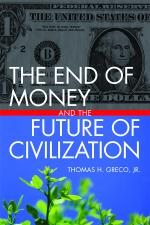 as relevant today as it was when first published the printed book has been out of print for several years. But, having had the rights reverted to me by my publisher, I am making the entire book available for free in PDF format. You can read it or download it HERE. If you would like a hard copy of the first edition used copies can still be found on Amazon.com, Abe books, Thrift books and elsewhere.
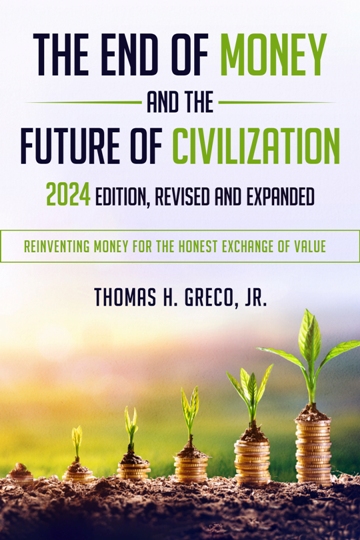 Better still, you can avail yourself of the new revised and expanded 2024 edition which I have been working on for almost two years and is almost complete. Eighteen chapters have already been posted and can be freely read or download HERE.
My previous books, as published, may be freely accessed in digital format by clicking the title below.
Money: Understanding and Creating Alternatives to Legal Tender (2001)
New Money For Healthy Communities (1994)
Money and Debt: a Solution to the Global Crisis (1980)
Collectors may find used and some new print copies of my books as published, on amazon.com and elsewhere online. Start by clicking on the title below:
Money: Understanding and Creating Alternatives to Legal Tender (2001)
 Beyond Money
 Beyond Money