
My latest article, Money, debt and the end of the growth imperative, was published today (March 3) in the online journal, Transformation. Read it here. –t.h.g.
The End of Money and the Future of Civilization
The first edition of my book, The End of Money and the Future of Civilization, was published by Chelsea Green Publishing in 2009. While it remains
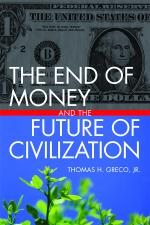 as relevant today as it was when first published the printed book has been out of print for several years. But, having had the rights reverted to me by my publisher, I am making the entire book available for free in PDF format. You can read it or download it HERE. If you would like a hard copy of the first edition used copies can still be found on Amazon.com, Abe books, Thrift books and elsewhere.
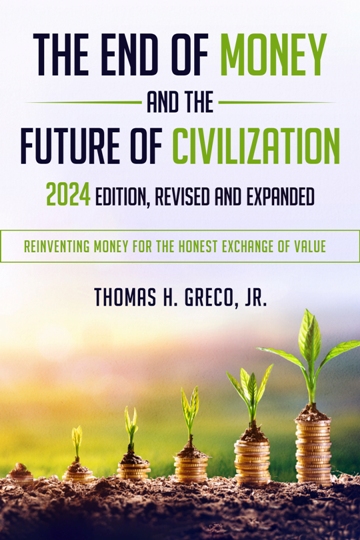
 Better still, you can avail yourself of the new revised and expanded 2024 edition which I have been working on for almost two years and is almost complete. Eighteen chapters have already been posted and can be freely read or download HERE.
My previous books, as published, may be freely accessed in digital format by clicking the title below.
Money: Understanding and Creating Alternatives to Legal Tender (2001)
New Money For Healthy Communities (1994)
Money and Debt: a Solution to the Global Crisis (1980)
Collectors may find used and some new print copies of my books as published, on amazon.com and elsewhere online. Start by clicking on the title below:
Money: Understanding and Creating Alternatives to Legal Tender (2001)
-
Join 931 other subscribers
Top Posts
-
Recent Posts
- A Tale of Two Systems March 15, 2026
- How To Be An Effective Leader? March 4, 2026
- What’s holding back the Paradigm Shift? February 17, 2026
- Taking Moneyless Exchange Successfully to Scale February 12, 2026
- Reclaiming Your Savings February 7, 2026
-
En español
-
- Arquitectura y operaciones de intercambio comercial: una conversación con Chip Davis y Charlie Davis
- Dinero, Poder, Democracia, y Guerra
- El fin del dinero y el futuro de la civilización
- El fin del dinero y la liberación del intercambio. Presentación en la Conferencia de Dinar de Oro 2007, Malasia
- La metamorfosis
- La Revolución del Intercambio: LLEVANDO EL COMERCIO SIN DINERO A UN NUEVO NIVEL
- Libertad de expresión contra las cuerdas.
- Liquidez y monetización: una monografía
- Reclamando el crédito como bien común
- Recuperando el crédito de los comunes. Rumbo a una Sociedad Mariposa.
- Reinventando el Dinero
-
En français
-
Στα Ελληνικα
-
My Audio-Visual Presentations
-
- 2004-06 Building Healthy Community Economies, presented at the Local Currencies Conference at Bard College
- 2006-02 How to Build Healthy Community Economies, Auroville, India
- 2006-02 How to Build Healthy Community Economies, Auroville, India–Q&A
- 2006-09 Keynote Presentation to the International Reciprocal Trade Association (IRTA)
- 2007-05 Lecture about the real secret of money
- 2007-06 China presentations. (Recordings not available)
- 2007-08 Auroville-Community and Economy: A rational approach to sustainability, harmony, and prosperity
- 2007-Presentation at the Gold Dinar Conference-The End of Money and the Liberation of Exchange
- 2009-05-05 The End of Money and the Future of Civilization-IONS
- 2009-08 The End of Money, Tucson
- 2009-08-24 Basic Business Issues for Enabling Local Exchange, Tucson
- 2009-10 Panel Sessions at the Economics of Peace conference
- 2009-10 presentation -The Economics of Peace, Justice and Sustainability
- 2009-11 My presentations at the Conference on Michigan’s Future Energy, Economy & Environment (files 140 and 141, and 595 and 596, respectively)
- 2009-11 The End of Money and the Future of Civilization
- 2009-Cutting Edge Capital Raising for Small Business--Panel Discussion
- 2010 Reclaiming the Credit Commons
- 2011 FPA Presentation-Financial Planning in the Emerging Butterfly Economy-Movie with narrative
- 2011 The Butterfly Economy-Movie
- 2011-11. The Emerging Butterfly Society – Thomas Greco
- 2012-A New Paradigm in Exchange and Finance: The pathway to peace, justice, freedom, and a dignified life for all
- 2013-06 Value Measurement Discussion
- 2013-Understanding Diverse Exchange System Models -- IRTA Panel
- 2014-10-The Evolution of Money and its Potential to Improve Humanity
- 2014-Money, Power, Democracy, and War
- 2016-10 A World Without Money and Interest: A pathway toward social justice and economic equity
- 2017 Disruptive Technologies Making Money Obsolete
- 2020 The Exchange Revolution: taking moneyless exchange to a new level
- 2020-04 A Conversation about the Dysfunctions of Money, and the Need for Decentralized Exchange Alternatives
- 2020-09 IRTA: The Butterfly Economy and the Role of Commercial Trade Exchanges In It
- 2020-09 What if things had gone differently?
- 2021-05&06 Webinar series: Our Money System – What’s Wrong with it and How to Fix it
- 2021-07 Solar Dollars–Empowering Communities While Powering Communities With Renewable Energy
- 2021-11 Transcending the present political money system–the urgent need and the way to do it.
- 2021-11 Transcending… Q&A
- 2022-09 Private and complementary currency systems-Summary
- 2022-09 Private and complementary currency systems: purposes, principles, practices, and performance
- 2023-02 Alternative Currencies and Solar Dollars–Why we need them; How they work
- 2023-02-Monnaies alternatives et dollars solaires. French subtitles
- 2023-08 The Tyranny that is the Global Money System
- 2024-07 Money, Power, Democracy, and War, a Webinar on Humanity Rising
- 2024-11 Invoice Factoring as the basis for a Digital token Currency: Full paper
- 2024-11 Invoice Factoring Video
- Just Cooperate–What we can learn from nature
- My 2 Minute “Elevator Speech” About Solving the Money Problem
- There once was a river, …an allagorical tale
-
My Interviews
-
- 2003-06-26 Democratizing Money on Network X
- 2006-03 Interview by Sebastian Cortes at Auroville, India
- 2009-10 Interview of Thomas H. Greco by Daniel Pinchbeck
- 2009 Interview on Green Planet Radio, New Zealand.
- 2009 Interview on New Dimensions Radio–Toward a Credit Commons
- 2009 Interview on New Dimensions Radio: Investing in the Bank of You and Me
- 2009-04. Thomas Greco's Interview by Kim Hill of Radio New Zealand.
- 2009-06 Interview on The Power Hour with Joyce Riley
- 2009-07 interview featuring Thomas Greco and Annette Riggs on The Power Hour with Joyce Riley
- 2009-10 Interview with Daniel Pinchbeck (4 parts)
- 2009-11-05 Thomas Greco Interview on KBCS, One World Report.
- 2010 (June) Interview of Thomas Greco by Ken Rose, KOWS
- 2010 (March) interview, Irish Side of the Moon
- 2011-06 Interview by KMO for C-Realm Podcast
- 2011 Interview by Frank Touby, The Bulletin, Toronto
- 2011 Interview by Hugh Reilly, ThatChannel, Toronto
- 2012 – The End of Money as We Know It and the Future of Civilization. Interview by Jay Taylor
- 2013-The Debt Growth Imperative. Interview with Community Currencies in Action
- 2014-12 Interview on Bartertown Radio
- 2015-08 The changing picture in complementary currencies
- 2017-03-15 interview on Primo Radical podcast #121
- 2019-02. Why the future of money is mutual credit (and not Bitcoin)
- 2019-10 interview on Ellen Brown's podcast, It's Our Money
- 2020-10 My interview with Patricia Cori on Beyond the Matrix
- 2021-04 Discussion with Intercoin founder Greg Magarshak
- 2021-05 — Conversation with Edgar Cahn, Tim Jenkin, et al
- 2021-12-30 Interview on It's Our Money with Ellen Brown
- 2023-02 Alternative Currencies and Solar Dollars–Why we need them; How they work
- 2023-04 My interview with Alasdair Lord, the "Renaissance Yorkshireman"
- 2023-05 My conversation with Emily Peyton and Jim Hoag
- 2024-02-24 Interview with Bruce de Torres on TNT Radio
- 2024-05 Interview with Pelle Neroth Taylor on TNT Radio
- 2024-07 Interiew on Humanity Rising with Jim Garrison
- 2025-03 Interview on Primo Radical
-
Recent Newsletters back to 2020
-
Researcch and Reviews
-
Excerpts and Monographs
-
- A Model Membership Agreement for a Credit Clearing Service
- An Objective Composite Standard Measure of Value
- Chapter 15 Limiting Factors in the Operation of Commercial Trade Exchanges
- Chapter 16 A Regional Economic Development Plan
- Chapter 17 A Complete Web-Based Trading Platform
- A Shared Equity Mortgage
- Youth Employment Scrip
- Credit Clearing – Pure and Simple
- Fundamentals of Alternative Currencies and Value Measurement
- Global monetary system is headed over the cliff—An Open letter to Jim Rickards
- How to Bring Liquidity Into an Economy, Free of Interest, Inflation, and Boom and Bust Cycles
- Liquidity and Monetization-a monograph
- Local Currencies—what works; what doesn’t?
- Money and Finance Have Now Been Completely Collectivized
- Money, debt and the end of the growth imperative
- New Money: A Creative Opportunity for Business
- Reclaiming the Credit Commons
- Solar Dollars – a way to promote renewable energy, while supporting the local economy and providing interest-free financing for utility companies
- Stop Chasing the Buck and Change Your Luck
- The Cooperative Community Commonwealth: A Prospective Outline for a New Socio-economic Framework
-
Other Resources
-
- Point and Counterpoint on Economic Exchange, Introducing the Credit Commons.
- Bitcoin, Blockchain, Crypto Resource List
- 50 Ways to Leave the Euro: Greece and the Global Crisis
- Walking Away From Civilization, Article Series
- Riba? Part 1 by David Pidcock
- The Farm community, links from Albert Bateshttps://beyondmoney.net/resource-links-from-albert-bates/
-
Recommended Sites
-
- A New Approach to Freedom
- Bartertown Radio
- Community Exchange System-CES
- Community Way
- Econ Talk interviews
- Ethical Markets
- Geopolitics-recommended authors, commentators, and sources
- Henry C K Liu
- Hidden History Center
- Ideas for an Alternative Monetary Future: Cato Institute
- Inspired Constitution
- IRTA-International Reciprocal Trade Association
- Low Impact Living
- MindDetox–Rafael Zambrana's Informative Blog
- Moneeey
- Monetary freedom bibliography of John Zube
- Monetary Realism--Merrill Jenkins
- Money as Debt, Video
- National Inflation Association
- New Currency Frontiers
- Nuet Nodes, Dr. Larry Victor's legacy
- Open Credit Network
- Open Money Project, Michael Linton
- Other Networks, Stan Pokras' answer ro Wikipedia
- Panarchy
- Peer-to-Peer Foundation
- Primo Radical Podcasts
- Program on Corporations, Law & Democracy
- Public Banking Institute
- Ratical Earth Journal, David Ratcliffe
- Richard C. Cook
- RT.COM
- The Essence of Money-Animation by Paul Grignon
- The Henry George School of Social Sciences
- The Henry George Academy
- The Henry George Institute
- The MetaCurrency Project
- The Monetary Future--Jon Matonis
- The Money Fix. documentary video
- The Money Masters: How International Bankers Gained Control of America
- Walter Zander
 Beyond Money
- A Tale of Two Systems
- How To Be An Effective Leader?
- What’s holding back the Paradigm Shift?
- Taking Moneyless Exchange Successfully to Scale
- Reclaiming Your Savings
- The West under oligarchy
- An Honest Money System
- The Money Problem–A Fix
- The End of Money Explained
- The amazing usefulness of AI! Rethinking Money Cretion
 Beyond Money