Category Archives: My activities

The International Commons Conference

The International Commons Conference held in Berlin, Germany, November 1 and 2, 2010 brought together 180 participants from 34 countries. The conference was sponsored by The Heinrich Böll Foundation and the Commons Strategies Group.

You can find a dossier of the conference highlights, including my six-minute speed presentation on Reclaiming the Credit Commons, here. There is also an ICC wiki, here.

For more information about the commons see the On The Commons website.

Summer Newsletter and other important stuff

I’ve just posted my summer newsletter to my other blog, Tom’s News and Views. This edition contains a lot of information about my recent activities, much of which is pertinent to the topics of Beyond Money. You’ll also find there some recent posts that relate to security and survival. Please take a few minutes to read these posts. — t.h.g.

The End of Money book one of top 15 “most shareable” of 2009

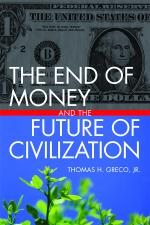
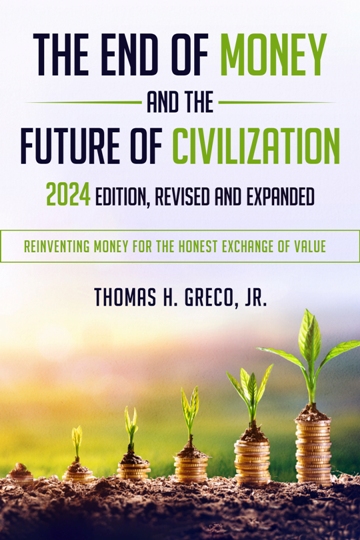
My latest book, The End of  Money and the Future of Civilization has been rated one of the top 15 SHAREABLE books of 2009. It shares this list with some very good company. Have a look. “Shareable is a nonprofit online magazine that tells the story of sharing.”  The guys who run it have some pretty impressive credentials.

The End of Money places second on P2P Foundation Top 10 list

Michel Bauwens, Founder and Director of the P2P Foundation, has rated The End of Money and the Future of Civilization number two on his 2009 list of the top 10 books in support of peer-to-peer practices.

In June 2009, the book was featured as P2P book of the week. My email interview can be seen here.

You can see the entireP2P  Top 10 list, with Bauwens’ comments, here.

Economics of Peace video now available

During the Economics of Peace conference last October I gave a presentation titled, The Economics of Peace Justice and Sustainability. The video of that presentation is now available in three parts for viewing online at: http://vimeo.com/channels/theeconomicsofpeace/page:4. In the near future, I plan to add to this blog the slide graphics that accompanied my presentation.

November Newsletter

Newsletter — November 23, 2009

Whew! The past two months have been a whirlwind—on-tour with appearances, conferences, and interviews, first in Pennsylvania, North Carolina and Texas, then following 10 days rest in Tucson—on to California, Oregon, Washington, BC, and Michigan. Now back in the San Francisco Bay area, I’ve been resting up as I contemplate what might come next.

An account of my eastern tour was included in my October message, so I’ll begin with a brief report on The Economics of Peace conference (http://www.economicsofpeace.net/) that was held in Sonoma, California during the fourth week in October. I was one of the featured speakers at that conference, presenting an illustrated talk titled, The Economics of Peace, Justice and Sustainability: Toward a New Convivial World Order.

The conference was one of the best I’ve ever attended, with regard to not only the program but the organization and the setting, as well.

Praxis Peace Institute Director, Georgia Kelly informs us that videos of The Economics of Peace conference are for now being uploaded to the Vimeo website http://vimeo.com/channels/theeconomicsofpeace. Among those available for immediate viewing are the presentations of Vandana Shiva, A. T. Ariyaratne, and David Korten. Later, the presentations will all be on the Praxis Peace home website http://www.praxispeace.org/.  DVDs and audio CDs will also be available sometime in December.

While in the Bay area, I also gave a presentation at San Francisco State University. This was at the invitation of long-time correspondent and friend Kenn Burrows who teaches in the department of Holistic Health Studies.

Noticing a two week gap between my California and Michigan commitments, Brian Allen offered to organize a tour of the Northwest. After deliberating about the pros and cons, I agreed to take him up on it. It turned out to be a very interesting and productive tour, with Brian skillfully handling the details every step of the way.

In Portland I worked with the Community Exchange Network (CEN/PDX) currency organizing group, putting on a workshop for them on Saturday, then on Monday afternoon we gave a presentation to city officials, among them, the Mayor’s economic development policy advisor. Adding a bit more substance to our presentation was William Underwood, organizer of a successful rebate program called Locals Care that has been operating in northern New Mexico for the past three years (https://www.locals-care.com/lcindex.php). That program has worked out some of the operational details associated with accessing existing payments infrastructure for use of with alternative currency.

The capstone of my Portland visit was a public lecture I gave on Monday night at the Unitarian church, which was well attended and successful in a variety of ways. The Portland people, like those in Asheville, inspired me with their dedication, commitment and intelligence. I’ve agreed to be on their advisory board.

In Seattle, I enjoyed the hospitality of the Ramer family, which afforded an opportunity for me to get a deeper understanding and an update on the Interra rebate project which Jon Ramer, with Greg Steltenpohl, helped to organize (http://www.interraproject.org/). That project utilized existing card reader technology and point of sale devices, but at rather high cost. If a greater scale of operation can be reached, the overhead might be bearable.

On Wednesday evening (Nov. 4), I gave a lecture on The End of Money and the Future of Civilization at the landmark Elliott Bay Bookstore. That presentation was video-recorded by Todd Boyle who has done a great job of merging the slide graphics with the video to create a movie that has been posted on vimeo. I’ve also added a link to it on my blog http://beyondmoney.net (in the sidebar to the right under My Audio-visual Presentations).

Canadian Visit

Taking a leisurely drive up the coast on November 5 with Brian and Carolyn, we arrived around dusk at the border crossing into Canada. I remember the days when going into Canada was almost as easy as crossing the street. Now, one needs to show a passport and submit to sometimes intensive interrogation and searches. Still, we managed to reach the dock at Tsawassen just in time to catch the last ferry to Salt Spring Island.

Salt Spring Island dollars were launched eight years ago. The nicely-designed notes, which are sold for cash, have had some success in raising funds for local charities but they have not circulated widely on the island. Many tourists acquire the notes and take them home as souvenirs. The Board members are now seeking ways to make their currency more meaningful to island businesses and residents. In my meetings with them, and in my public presentation, I proposed that they change the method of issuance to monetize the local value-added by Island businesses, preferably within a mutual credit clearing association, as I’ve outlined in my recent book. That message seems to have been well received and I’m hopeful that the Salt Spring Island local exchange project may soon evolve into a good model for other communities to follow.

While on the Island, I had occasion to meet Paul Grignon, creator of the excellent videos, Money as Debt, (parts I and II). Paul came to my presentation on Salt Spring Island and brought with him a new short video called The Essence of Money, a Medieval Tale. In less than eight minutes, this video explains as well as anything I’ve seen how simple and effective a community-created currency can be. I highly recommend it. You can view it here: http://www.digitalcoin.info/The_Essence_of_Money.html

Back to the USA

Upon returning to the U.S., I gave presentations on both Whidbey Island and Vashon Island. Whidbey has recently launched a currency and Vashon people are considering one. In both cases, I stressed the importance of scale and of starting by recruiting “trusted issuers,” i.e., the popular businesses in the community where everyone wants to shop. These are the members that should be first to have the overdraft privilege (lines of credit) that allows them to spend before they earn. Individual members should initially be required to earn before they spend.

On Whidbey, I gave a presentation at the Whidbey Institute and had substantive discussions with the founders of the currency project. On Vashon, I was the guest of the Vashon Co-housing community. The talk I gave at the Red Bicycle Café was imbedded in an evening of enlightenment and entertainment that included songs sung and played by a local entertainer, a different kind of format that everyone seemed pleased with.

Last Stop

The final stop on the tour was Traverse City, Michigan where I was a presenter at the Conference on Michigan’s Future Energy, Economy & Environment (Nov. 13-15, 2009, http://futuremichigan.org/). My presentation on the first day of the conference (Friday) was billed as “Why the Economy is Collapsing.” My coverage of that topic was contained in my slide show that I titled, The Economy: How Did we Get Here and Where are we Going?

My second presentation (Sunday afternoon) provided a more detailed outline of how to design, manage, and issue complementary credits or currencies. The listed title was “Local currencies and credit currencies,” but I ended up calling it The Exchange Revolution: Taking Cashless trading to a new level. The narrative (MP3) and slide show (pptx) for each of these presentations are currently posted separately at http://www.mediafire.com/?sharekey=b3d291f68f7542fdab1eab3e9fa335ca80431dd425797f76 (files 140 and 141, and 595 and 596, respectively). You can download a free Power Point viewer for pptx files from the Microsoft website.

At the end of my stay in Traverse City, I met with the Board of the Bay Bucks local currency project, two members of which are old friends from the Bioregional gatherings of the 1980s. They, too, are looking for ways to make their currency more significant to their local economy. I offered them the same advice I gave to the others—show the most popular businesses in town the advantages of spending their own currency jointly into circulation. With a little seed money, Traverse City could become another good model for community exchange.

I could give lots of interesting details on all of these experiences but for the sake of brevity I’ll refrain.

Priorities

My main priority at this point is to show alternative exchange entrepreneurs in both the grassroots and for-profit realms where the real liberating power lies. It’s in reclaiming the credit commons by monetizing the value-added by local industries, farms, and other businesses. What that means is organizing the productive enterprises in a community to pool their credit and to allocate it to one another in proportion to each business’s ability to provide valuable goods and services to their community. This is accomplished by their participation in mutual credit clearing exchanges and/or by jointly issuing a local currency and spending it into circulation. It can also be accomplished by participation in well-managed commercial “barter” exchanges.

I’m encouraged to see that this approach is increasingly understood and gaining ever greater traction. Several promising projects are either nearing launch or are shifting over from less empowering designs. There is an urgent need now for (1) grant funding or investment capital to build optimal exchange models that can be quickly scaled-up and replicated, and (2) a “space” for collaboration where developing exchange projects can learn from and assist each other. We don’t have time to reinvent any wheels. Solutions that have already been worked out and tested in one place can be applied or adapted for use elsewhere. There are plenty of good tools available for web-based collaboration and information sharing. It remains only for someone with the requisite knowledge and skills to show how they might be effectively combined and applied.

In the coming months, I am also looking forward to shifting my attention back toward more creative work—writing articles and, perhaps, another book, while exploring new realms, physical, cultural, and spiritual.

As I’ve said many times of late, I think society is going through a metamorphic change. It is something unprecedented, something that requires us to be responsible, creative and open to possibilities. It means a shift away from economic growth and the consumerist rat-race, toward a sustainable, steady state economy and a dignified life for all. Those who try to cling to the caterpillar economy are bound to be sorely disappointed. With sharing and cooperation we can make the transition to the “butterfly economy” both exciting and rewarding.

Happy Holidays,

Tom

West Coast Tour Presentations

My speaking tour of the west coast began with the Economics of Peace conference in Sonoma, California, and continued with stops in Portland, Seattle, Salt Spring Island, BC, Whidbey Island, and Vashon Island, Washington. Most of these have been recorded and will eventually be posted.

My Seattle presentation at Elliott Bay Bookstore is available for viewing now. It was video-recorded by Todd Boyle who has inserted the slide graphics and posted it on vimeo. I’ve added a link to it on the sidebar to the right under My Audio-visual Presentations.

Review and Opinion by Richard C. Cook

Richard C. Cook’s review of my book, The End of Money and the Future of Civilization, combines some of my main points with his own insightful observations, and has stirred up a lot of interest. Besides appearing on his own website, the review has been picked up by a number of others, including Global Research, The Market Oracle, Dandelion SaladAfter Downing Street, Snuffy Smith’s Blog, and Disident Voice.

Cook’s own work is worth following closely. He a former federal government analyst who writes on public policy issues. His website is www.richardccook.com. His latest book is We Hold These Truths: The Hope of Monetary Reform (Tendril Press, 2009). His career included service with the U.S. Civil Service Commission, the Food and Drug Administration, the Carter White House, NASA, and the U.S. Treasury Department. He also taught history at the Field School in Washington, D.C., and owned and operated an organic farm for 10 years while commuting to work from rural Virginia.

Activity Report and Upcoming Tour

I’ve been extremely busy of late doing radio interviews by telephone, preparing upcoming presentations, keeping up with correspondence, and adding content to my blogs. As I get these interviews and presentations processed and edited, they will be added here. See the sidebar under My Audio-visual presentations.

I’ll soon be on the move again doing presentations and visits in various parts of North America. Here’s a partial list of my still evolving itinerary.

Featured presentation. Sustainable Tucson, August 12, Tucson, AZ. http://www.sustainabletucson.org/

Keynote presentation. Pennsylvania Renewable Energy and Sustainable Living Festival on Sept 18-20, 2009 in Kempton, PA. The festival is hosted by the Mid-Atlantic Renewable Energy Association (MAREA). http://www.paenergyfest.com/general.shtml

Featured speaker. The International Reciprocal Trade Association (IRTA), October 1-3, Dallas, TX. http://www.irta.com/

Featured speaker. The Economics of Peace conference, October 18-23, Sonoma, CA. http://economicsofpeace.net;  http://www.praxispeace.org

Presenter. In the lecture series titled Reinventing the World––Redefining Wealth, Rethinking Economics, Reforming Health Care & Rebuilding Community. October 27, San Francisco State University, San Francisco, CA.

Keynote presentation at The Conference on Michigan’s Future Energy, Economy & Environment, Crystal Mountain Resort, Thompsonville, Michigan, Friday, Nov. 13 – Sunday, Nov. 15, 2009. http://futuremichigan.org/index.htm

New Dimensions Radio Interview

Before leaving California in May, I journeyed to Ukiah where I spent a couple hours being interviewed by Michael and Justine Toms for their nationally syndicated New Dimensions radio program. (See description below). That program is scheduled to air during the week of September 23-29, 2009 (their broadcast week begins on a Wednesday).

A shorter (11 minute) interview that we did, entitled “Toward a Credit Commons,” is available now and can listened to or downloaded at New Dimensions Café. Go to http://www.newdimensions.org and on the left-hand side click on New Dimensions Café Listen Now!  If you would like to subscribe to the New Dimensions Café podcast which features many of the guests that appear on New Dimensions, it is available for a free subscription on the home page as well.

The one-hour “flagship” New Dimensions radio program, “Investing in the Bank of You and Me” (Program 3308) will be airing the week beginning Wednesday, September 23-29. You can hear it streaming on the New Dimensions website that week for free. You can also hear it on a radio station close to you during that week. Go to “Listening Options” in their website for a list of stations that carry “New Dimensions.” It will also be available to download for a small charge. This interview, as well as over 850 others, is part of their wonderful archive. New Dimensions is working in partnership with Stanford University Library to digitize their entire archive of over 8000 hours of deep dialogues with hundreds of the most innovative movers and shakers on the planet.  More hours are added to the archive every week.

INVESTING IN THE BANK OF YOU AND ME, with THOMAS GRECO, Jr.

Our financial system is in disarray. In 2008 and 2009 banks and investment companies have collapsed faster than taxpayers can dish out money to prop them up. At the same time the United States economy is being depleted as rapidly as the rainforest, and our global credit is looking as dingy as our once pristine rivers. But Thomas Greco has a solution. With his fresh perspective on money, credit, and…well…civilization, he believes we can save our economy and our planet by reconstructing our financial system—and find ourselves happier and healthier in the bargain. By reclaiming control over our money and credit, so that neighbors rather than banks are at the center of our transactions, we can restore balance to every aspect of our lives. Mr. Greco tells us, “We’re facing a mega-crisis that includes several things converging at the same time. We’ve got peak oil, we’ve got climate change, we’ve got resource depletion, we’ve got pollution. Our institutions are failing us—they fail to educate, they fail to provide health care adequately to everyone. And so we have to take a hard look at what we’ve been doing and look at new ways of doing things. We’re about to embark on an existence that’s quite different from the past, a new steady-state economy. I see it as a more peaceful, more pleasant life for everybody. Hopefully we’ll see an end to war. We’ll see an end to starvation. We’ll see an end to deprivation of the essentials that we all need, and an opportunity to realize our full potential.”

Among the topics to be covered:

  • Why the global political money and banking regime is extremely dysfunctional
  • How our monetary system contributes to the depletion of the earth’s resources
  • How community based initiatives are available to reclaim the “credit commons,” empower people, and enhance the health of local communities
  • Why local, grassroots currencies have failed—and how we can help them thrive
  • How you can get credit without going to a bank

Recent Articles

I recently wrote a couple articles that were published in the web journal, Alternet. Both are linked from my blog, beyondmoney.net. The first is titled, How Bad Will the Economy Get? It begins with the claim that:

Historically, every financial and economic crisis has been used to further centralize power and concentrate wealth. This one is no different, and in fact the moves being promoted by the Obama administration and the central banks of the Western powers will take the whole world to the pinnacle of financial despotism — unless enough people wake up and claim their own “money power.”

It continues with an outline of recent and historical developments that make the case, but concludes on a hopeful note with my brief description of existing cashless exchange mechanisms that are not dependent upon political money or banks. You can read the complete article here.

The second, titled, The End of Money: Take Power Back From the Money and Banking Monopoly, begins:

The dysfunctional nature of the dominant global system of money and banking has for a long time been apparent to anyone who has cared to look at it. Now, in light of the present financial meltdown, it has become painfully obvious to virtually everyone. What most people have failed to recognize is that, regardless of the nominal form of their government, their political power has been neutralized and exhausted by the privatization and misallocation of credit money.

The political money and banking system disempowers communities and enables a small elite to use the present centralized control mechanisms to their own advantage and purpose. It misallocates credit, making it both scarce and expensive for the productive private sector while enabling central governments to circumvent, by deficit spending, the natural limits imposed by its above-board revenue streams. Read more..

That article also explains how the “Greenback solution” being proposed by many monetary reformers, fails to address the fundamentally undemocratic nature of centralized control of money.

Be sure also to view the important imbedded videos on this site featuring Peter Schiff, Matt Taibi, and Congressman Alan Grayson.

This is a time of transition that requires us to inform ourselves and to take responsibility for our own health, education, and wellbeing, not in isolation but in communities of cooperation, sharing, and mutual support.  –t.h.g.

More Interviews

Over the past few months I’ve given many interviews in which I answer questions and discuss my ideas about money, the exchange process, and how to make the transition to a steady-state economy and a more just and peaceful world. I try to post links to those interviews here on my blog. You’ll find them in the sidebar to the right under “My Audio-visual Presentations.”

One of these, is an 11 minute excerpt titled, Towards a Credit Commons with Thomas H. Greco, Jr., posted on the New Dimensions Radio website at the New Dimensions Café. You can download it from there. The full interview is scheduled to air during the week of September 23-29, 2009. Check the New Dimensions website for radio stations in your area, or to find out about other Listening Options.

I’ve also just posted the interview I did with Joyce Riley for her Power Hour radio show on June 30, 2009, and will soon be posting a follow-up interview with her that was recorded on July 29. That program will also feature commercial trade exchange operator, Annette Riggs (Community Connect), who answers questions about the practical details of operating a private cashless trading system.