Showdown looming over shutdown

Once again, the Democrats and Republicans in Washington are facing off in a battle over the budget. The Republicans, who control the House, are demanding huge cuts that would pull the teeth from regulatory agencies, like the EPA, Fish and Wildlife, and the IRS, decimate social programs in health and education, including Medicare. Some of the details are provided in this New York Times article.

The elite agenda has long been apparent– to further concentrate power and wealth in their hands, to reduce the middle-class to serfdom, and to change the nature of our government to something more akin to imperial Rome or the fascist states of the 20th century. That agenda, since the start of the Reagan-Thatcher era of the 1980’s, has been advancing under both Republican and Democratic administrations with only moderate variations in its pace.

Here are the questions that come to my mind as we approach what appears to be a critical juncture:

1. Are the Democrats in Congress really making a sincere attempt to oppose the elite agenda and protect the general interests of all the people, or is their vocal opposition just for show?

2. How far will the American people allow themselves to be pushed before they will stand up for themselves and for the common good?

3. And when they do stand up, what form will their actions take, and will it be in time to avoid an ugly and destructive confrontation?

I have often thought that Franklin Roosevelt saved capitalism in the 1930s by instituting a wide range of programs under the “New Deal” that curbed abuses of power by Wall Street and corporate leaders and provided for a more equitable distribution of the economic pie. There were a few hard liners who disagreed with that and actually tried to engineer a coup d’état to depose him. Fortunately, that attempt failed when Major General Smedley Butler refused to go along with it.

So, here we are again in the midst of an economic depression, but this time the redistribution of wealth is going in the opposite direction, which can only worsen our predicament. And, no, there will not be a new “New Deal.”

Many things have changed drastically over the past 80 years. Some of these like surveillance technologies and advanced weaponry have favored the presently dominant force of centralized control, while others like microcomputers, the internet, and cheap global person to person communications have favored the emergent force of decentralized power and global community. Society is being rebuilt from the bottom upward, community by community. Those efforts will need to be rapidly ramped up in the face of increasingly dysfunctional national governments.

As David Stockman, director of the Office of Management and Budget under President Ronald Reagan, said to state and local political and business leaders a couple years ago, “Washington will become a fountain of harm as you struggle with our own problems.” And so it, not just in Washington, but in Athens, London, Rome, and capitals around the world.

#     #     #

Green Fast Food Chain Beats Competition in Sweden and Elsewhere

I was recently a panelist at a seminar on the island of Gotland, Sweden along with Par Larshans who happens to be the chief sustainability officer for Max Burgers, Sweden’s No. 1 burger chain. Par sent me a link to an article that appeared about a year ago in Time magazine. The article,Why Going Green Can Mean Big Money for Fast-Food Chains, describes the phenomenal business success that Max achieved as it took measures to reduce it’s carbon footprint and provide healthier choices for its customers. Read it here. — t.h.g.

Government of Kenya attacks self-help program in Mombasa slums

In an unbelievably heavy handed move, the Government of Kenya last week arrested an American aid worker and five local micro-entrepreneurs for operating a complementary exchange system in a poor suburb of Mombasa.

The recently launched Bangla-Pesa voucher system is intended to provide additional liquidity that makes it possible for unmet needs of local residents to be satisfied out of their own excess productive capacity. In just two weeks of operation, the amount of goods and services traded among the members of the Bangla-Pesa network increased substantially. Now, the program is shut down and six people are facing seven years in prison.  Why? Is this simply a case of ignorance on the part of government officials, or an attempt to keep poor people poor and dependent upon inadequate or even exploitative systems that are controlled by bankers and politicians ? The answer to that will become clear as this case develops. Your help is needed to get this matter resolved in favor of freedom, justice, and rationality. Here is the official appeal from American aid worker Will Ruddick.

Dear Friends, Family and Supporters,

End Africa’s dependence on Aid through Complementary Currencies. Eradicate poverty and keep six people from seven years in prison.

Click here to support this program and watch our videos.

Bangla-Pesa, a complementary currency program in one of Kenya’s poorest slums, needs your help. This innovative program gave participants the ability to create their own means of exchange so micro-business owners could trade what they have for what they need. In two weeks, the program already showed great success. But the Central Bank of Kenya has deemed the program illegal and is pursuing a legal battle against its organizers, despite enthusiastic community support.

These six people face charges that could put them in prison for as much as seven years:
·         Alfred Sigo a youth activist.
·         Emma Onyango a grandmother and community business owner.
·         Rose Oloo a grandmother and community business owner.
·         Paul Mwololo a grandfather and community business owner.
·         Caroline Dama a mother and volunteer.
·         Will Ruddick a new father and program founder.
We need help raising funds for legal fees and to bring this program back to life so it can help people throughout Africa in expanded form via mobile phones.
Our goal is to raise 47,000 Euros over the next 47 days.

Click here to read more and donate:
http://igg.me/p/bangla-pesa/x/31801
Spread the word!
Sincerely,
Will Ruddick, Bangla-Pesa Program Founder

End poverty by ending the corrupt central banking system

Thirteen year old Victoria Grant speaks truth to power in calling for a massive change in the way we do money and banking. Brilliant!

Corrupción Extrema, la causa de la Extrema Pobreza. subtítulos en español

NSA whistleblower challenges “Big Brother”

In an act of tremendous courage and commitment to “government by the people,” Edward Snowden has revealed the abusive power that is being wielded by the United States government, in particular through the National Security Agency (NSA), at which he was employed.

Here below is a video interview of Snowden by Guardian (UK) columnist Glenn Greenwald, in which Snowden  explains his actions.

http://youtu.be/3P_0iaCgKLk

You can read the related Guardian article here.

And here blow is a CNN interview of Greenwald in which he explains what the NSA and the tech companies have said about the PRISM program of collecting personal communications of ordinary American citizens.

http://youtu.be/k6NyiFMrDqY

In my latest book, The End of Money and the Future of Civilization, I included a chapter titled, The Contest for Rulership—Two Opposing Philosophies, in which I attempted to outline the inevitable conflict that will decide what kind of world we will live in. Here is the first part of that chapter:

Chapter 3. The Contest for rulership—Two Opposing Philosophies

There appears to be a general tendency for those who get a little power to try to acquire more of it—and like an addictive drug, power’s ability to satisfy seems to depend upon its use in ever-larger doses. Lest the following be misunderstood, let me say at the start that I believe the same tendencies exist in every one of us, and that our efforts to improve our collective lot should not be cast as an “us versus them” contest. When I speak of ruling “elites” it is not to cast them as “evil” in opposition to the “virtuous masses,” but to explain the distortions in human affairs that have developed over time and to suggest what may be needed to give civilization a chance of evolving toward higher levels of achievement and a more harmonious condition.

Elitist or Egalitarian?

In 1944, F. A. Hayek warned that the western democracies were on the same “road to serfdom” that had been followed by fascist Germany and Italy (and communist Russia) during the early twentieth century.

He characterized the political contest as being between socialism on the one hand, and capitalism on the other—equating the former with “collectivism” and the latter with “individualism.” Hayek’s dichotomy is, I think, an overly simplistic characterization, and the fundamental struggle goes beyond particular political ideologies or economic systems however one might wish to define them. In my view there is a contest raging in the world that is more fundamental and less apparent than Hayek’s. It is one that impinges directly upon our freedom, our dignity, and our morality. It is a struggle between what might be called elitism on the one hand, and egalitarianism on the other. By elitism I mean the centralized rulership exercised by a small privileged class, while egalitarianism implies the dispersal of power and popular self-government. As Lord Acton keenly observed, “Power corrupts, and absolute power corrupts absolutely.” Whether that power be wielded through political office or economic dominance makes little difference; the outcome is the same. It is easy for those who live far above the masses to delude themselves into thinking that power and privilege are their “right,” and that whatever serves the narrow self-interest of their class, or race, or religious group also serves the general interest.

Hayek was sensitive to the defects of communism, but he seems to have been blind to the defects inherent in capitalism that make it equally susceptible to becoming totalitarian and tyrannical. The defining feature of totalitarian systems is the centralization of power and control, whether it be economic, political, or social, for these three are but facets of one whole. Considering the millennia of institutionalized hierarchy in our societies, Laurence Victor goes so far as to say,

I believe that [bureaucracies] are strong attractors for human psychopaths. In fighting their way to the top, individuals are selected who have the greatest tolerance for collateral damage of their actions. Today, the top [levels] of most power echelon hierarchies are populated by psychopaths. . . . The greater the power, the greater the collateral damage required and the greater the deception—both to others done damage [to] and those who are indoctrinated to damage others.[There are] two alternative modes for coordinating activity so as to accomplish what only many hands in coordinated activity could accomplish. The egalitarian mode involves voluntary cooperation to achieve requisite coordination. An exemplar might be a tribe’s collective effort in gathering materials and constructing a long house. The egalitarian mode can have leaders or managers, as roles to assist in coordination. Ideally, each person contributes as to their existing competencies and interests—and all essential roles are covered. The elitist mode involves forced labor in a top down command structure to achieve coordination (and even to get persons to act as demanded). The force could be facilitated by slavery or wages, both essential for survival in the prevailing situation. Once a people settle into an elitist mode, it must be defended by force and the indoctrination of labor to accept their status.

For that reason,  any excuse for concentrating power and curtailing the personal rights and freedoms to which all are entitled, even national defense or a “war on terror,” must be viewed with suspicion—for as H. L. Mencken observed more than seventy years ago, “The whole aim of practical politics is to keep the populace alarmed (and hence clamorous to be led to safety) by menacing it with an endless series of hobgoblins, all of them imaginary.” The real hobgoblins, often created by government itself, can be effectively addressed only by a responsible citizenry acting together from its community base.

Law, by itself, is incapable of restraining the behavior of the addict, for addiction creates imperatives that are stronger than the inhibitions induced by law. But, beyond that, power addicts’ need for ever more power leads them to seek ways to control the very process by which laws are made, changed, and adjudicated. While the separation of governmental powers into executive, legislative, and judiciary functions was intended to offer some assurance of pluralism and impartiality, the ever-widening socioeconomic differences have the effect of drawing these functions together into the hands of power elites whose members possess shared interests that are typically antagonistic to those of the masses who comprise the rest of society. As legal constraints upon concentrated power are gradually nullified, government becomes a weapon against freedom, and the ruling class tightens its grip. The people must be ever watchful for the telltale signs of creeping totalitarianism—government secrecy, stonewalling, obfuscation, classified information, abuse of prisoners, surveillance of citizens, harassment of dissenters, appeals to national security and executive privilege, and covert interventions in the affairs of other countries. These signs have been plainly evident in America for some time, and the trend toward totalitarian government has been ramped up since the events of September 11. This is clearly shown in Naomi Wolf ’s book The End of America, which outlines ten steps common to all transitions from democratic to totalitarian rule, and shows how they are already manifest today in the United States. Chalmers Johnson, in his Blowback trilogy, has clearly described how America’s imperial overreach has all but destroyed our republican form of government.

It is said that “the price of freedom is eternal vigilance,” but it cannot end there—vigilance is but the beginning of freedom. The acquisition and preservation of freedom require, in addition, responsible civic action. An informed, organized, and politically active citizenry is the only kind that has any chance of remaining free. {end of excerpt}

So long as we put material things foremost, and so long as we remain dependent upon their system of money and their banks, they will continue to control and dominate us. But we have it within our power to declare our economic independence, share the resources we have at our disposal, and apply our skills and talents to serving the common good.

My expectation is that increasing numbers of “cracks” (like Snowden’s revelation) within the despotic systems of control will lead the top level rulers to prematurely attempt to spring the trap on democratic government. This departure from “gradualism” will provide enough contrast to enable people to see what is being done to them, and to recognize that their fundamental common interests are at stake. Hopefully, we the people will assert our collective will in coordinated peaceful action that will turn the tide toward popular control and a world that works for everyone.–t.h.g.

A few words of gratitude +

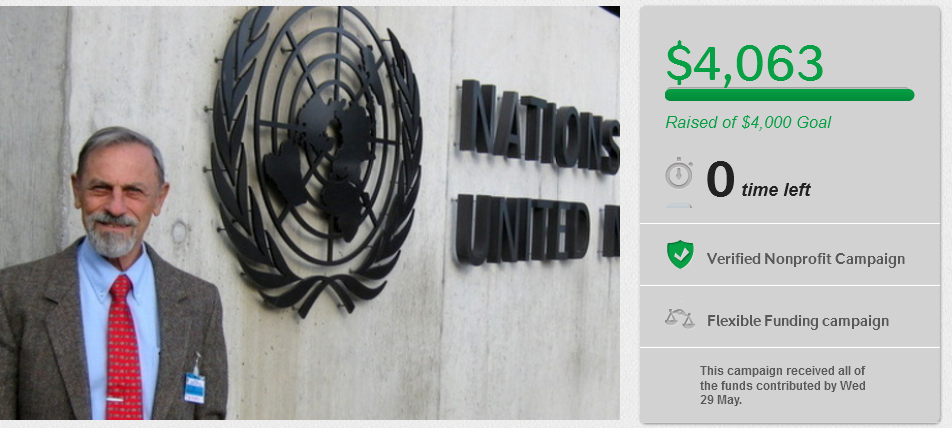
ScreenIndiegogo June3We’re on our way! Thanks to you our crowdfunding campaign has exceeded our goal. We are now assured that we will have sufficient funds to carry out our planned work in Europe this summer. Altogether, the tour will span 9 weeks from mid-June to mid-August. The first half is pretty solidly booked with multiple events in the Netherlands, Sweden, the UK and Greece; the second half is a bit more flexible with some room for spontaneous developments.

As you know, the debt crisis continues to worsen. Austerity for Greece is still in the news, and depositors with funds in Cyprus banks have been forced to take a “haircut.” Don’t be surprised if bank deposits in other countries get raided in like manner by their respective governments.

While the spotlight is presently on Europe, this crisis is global and bound to worsen. Virtually every country of the world has a central bank, and those in the developed world at least, work together. Every one of them is set up to allow their respective governments to deficit spend, and banks to lend our own credit back to us at interest. They will monetize the debt to whatever extent is necessary to keep the game going. The exponential growth of debt is inherent in the way money is created. It must stop somehow, sometime. All efforts to keep it going are futile in the long-run.

Currency inflation and cuts to social programs are the paths that bankers and policy makers have chosen, but that will do no more than delay the inevitable, and in the process create more pain for the masses. Either we create new methods for exchange and finance, or we descend into chaotic collapse and widespread civil unrest.

Let us hope that this year will see the widespread emergence of decentralized, community-based, credit-clearing networks. That’s what my mission is all about, and that’s our the best approach to making a peaceful transition to a steady-state economy and sustainable way of life.

Again, my sincere thanks for your help in supporting this important work!

Thomas

Non-violent revolution, is it possible?

What will it take to bring about a civilization that is peaceful, equitable and happy? This is a key question that I have been contemplating for the almost four decades during which I’ve come to realize the fundamental changes that are required in order for a convivial civilization to emerge.

In my most recent book, The End of Money and the Future of Civilization, I drew upon Prof. Philip Zimbardo’s work on human behavior and the lessons learned from his famous Stanford Prison Experiment. Just recently I happened to hear on the TED Radio Hour on NPR, a fascinating program that explored, The Violence Within Us. Besides Philip Zimbardo, talking about “Why Do Good People Do Bad Things?”, the program featured three other related segments as follows:

Jim Fallon: What Does The Mind Of A Killer Look Like?

Leslie Morgan Steiner: Why Don’t Domestic Violence Victims Leave?

Steven Pinker: Is The World A Less Violent Place?

These segments, each dealing with a different question relating to violence comprise one of the most thought-provoking programs I’ve heard in a very long time. I think we can learn a great deal by contemplating the facts and ideas presented. Please visit the program page and have a listen.

Update: Crowdfunding and 2013 Summer tour

Great news! Summer is almost upon us and I’m excitedly making preparations to begin my European tour. With  two full days to go in our Crowdfunding campaign, we’ve successfully raised our target amount of $4,000! Thank you to everyone who’s helped make that happen!  It really is so wonderful to have your support. Thank you!

Of course, we don’t want anyone to feel left out! You can still help out by donating here at our Indiegogo site: http://igg.me/at/tomstour/. Funds raised above the original target will be used to redesign and update our websites and upgrade our email service, greatly improving our service to you. You all have my deepest gratitude for your generosity!

Here’s an update on my agenda

I’ve been invited to give a number of presentations and workshops. Starting in the Netherlands, I will be making a presentation hosted by STRO on the evening of June 18 (19:00 – 21:30) in the Hague. That presentation, intended for practitioners and social entrepreneurs, will describe the various issues that must be considered in creating and managing alternative exchange mechanisms. Both Time/bank The Hague and STRO will also give short presentations. The location is “Quartair” in the Hague, close to the CCS conference centre. In this building Time/bank also will host an exposition during the CCS conference.

The 2nd International Conference on Complementary Currency Systems (CCS), which is also in the Hague, begins the following day and runs until the 24th of June. My conference presentation (on June 20) is titled, Reinventing Money: How Complementary Currencies and Mutual Credit Clearing Can Create a Sustainable, Regenerative Economy. I’m also slated to be a panelist for two other sessions on June 21. One of these will address the topic of The Future of Community Currencies, and the other, Control of new types of e-money by financial regulators. Conference details and registration information can be found here.

Following the Hague conference, I will travel to Sweden for a stay of almost two weeks during which time I will give presentations and meet with community currency people in Gottenborg, Lindsberg, Gotland, and Stockholm.

From Sweden, I will travel to England to present at an all day workshop in Lancaster, Unlocking Local Wealth, an event organized by the Institute for Leadership and Sustainability (IFLAS) of the University of Cumbria Business School, in association with the New Economics Foundation and the United Nations Non-Governmental Liaison Service, with the support of Impact International. You can find the program for that event here.

I expect to remain in the UK for a week or more then travel on to Greece for an extended stay in Volos, Crete, and Athens. Visits to other places are also possible and I’m expecting important opportunities to develop spontaneously, as they invariably do. I’m scheduled to return to the U.S. on August 21.

Thanks again for your interest and support! Once again, here’s the link where you can invest in my ability to serve you all better moving forward: http://igg.me/at/tomstour/

Thomas

TG_meme_3.2

Milestones in Moneyless Exchange

TG_meme_2_sm

I often compare the evolution of exchange alternatives to the development of aviation. Just as many early attempts to fly were clumsy and poorly informed by good science, so too have been many early attempts to create private and community currencies. But much has been learned over the past three decades, and conditions are ripe for major advances in our ability to rise above antiquated and dysfunctional means of  payment. My role is to guide the design and implementation of community based currencies and trade exchanges that enable general prosperity and a stable and sustainable economy.

During my upcoming tour of Europe I will be speaking about the power of community currencies and mutual credit, and consulting with communities on doing good things where they are.

With still two weeks to go, our Crowdfunding campaign is now more than halfway toward our goal. Thanks for your support, and please help spread the word. Our campaign site is http://igg.me/at/tomstour/x/31801.

Spring Update

Dear friends,

It’s high time for us to reclaim the credit commons and I need your help.

I will be traveling to Europe this suTG_meme_2mmer to push forward the movement toward complementary currencies and moneyless exchange, and to preach the “gospel” of decentralized credit-clearing networks.

So far, I’m slated for speaking engagements, workshops, and consultations in the Netherlands, Sweden, the UK and Greece. There may be room to add other stops to the tour so if you want to organize an event, contact me and we’ll see what fits!

Right now however, I need YOUR help to cover the lodging and travel costs. Please help spread the word about my Crowdfunding campaign to your networks! Share this image meme and the campaign link: http://igg.me/at/tomstour/.

We have thus far received $1207 from 21 very generous donors. My sincerest thanks to everyone who’s pitched in already and to those who help me achieve this goal by pledging and sharing!

Thomas

P.S. In case you missed my Spring, 2013 Newsletter, you can find it here.