Here’s and excellent, short and sweet description of how mutual credit clearing works to provide interest-free liquidity. From Bartercard New Zealand…

Important insights from Marjorie Kelly
I first met Marjorie Kelly more than 15 years ago when we were both privileged to be participants in a series of colloquia organized by the late Willis Harman (then Executive Director of the Institute of Noetic Sciences) and Avon Mattison of Pathways to Peace. I was, from that first meeting, quite impressed with Marjorie’s intelligence and passion for positive change. She founded, and for 20 years published, Business Ethics magazine. She is the author of The Divine Right of Capital and recently, Owning Our Future: The Emerging Ownership Revolution.
Her recent article, Living Enterprise as the Foundation of a Generative Economy, raises fundamental questions about the economy, corporations, and generative ownership designs. It is one of the most insightful and important articles I’ve ever read on the topic of organizing for sustainability. Here are a few excerpts. –t.h.g.
“What kind of economy is consistent with living inside a living being?” .…
You don’t start with the corporation and ask how to redesign it. You start with life, with human life and the life of the planet, and ask, how do we generate the conditions for life’s flourishing?
If you stand inside a large corporation and ask how to make our economy more sustainable, the answers are about incremental change from the existing model. The only way to start that conversation is to fit your concerns inside the frame of profit maximization. (“Here’s how you can make more money through sustainability practices.”) Asking corporations to change their fundamental frame is like asking a bear to change its DNA and become a swan. ……
Can we sustain a low-growth or no-growth economy indefinitely without changing dominant ownership designs?
That seems unlikely. Probably impossible. How, then, do we make the turn? How can we design economic architectures that are self-organized not around profit maximization, but around serving the needs of life? ……
In ownership design, there are five essential patterns that work together to create either extractive or generative design: purpose, membership, governance, capital, and networks. Extractive ownership has a Financial Purpose: maximizing profits. Generative ownership has a Living Purpose: creating the conditions for life. While corporations today have Absentee Membership, with owners disconnected from the life of enterprise, generative ownership has Rooted Membership, with ownership held in human hands. While extractive ownership involves Governance by Markets, with control by capital markets on autopilot, generative designs have Mission-Controlled Governance, with control by those focused on social mission. While extractive investments involve Casino Finance, alternative approaches involve Stakeholder Finance, where capital becomes a friend rather than a master. Instead of Commodity Networks, where goods are traded based solely on price, generative economic relations are supported by Ethical Networks, which offer collective support for social and ecological norms.
Ownership is the gravitational field that holds an economy in its orbit. Today, dominant ownership designs lock us into behaviors that lead to financial excess and ecological overshoot. But emerging, alternative ownership patterns – when properly designed – can have a tendency to lead to beneficial outcomes. It may be that these designs are the elements needed to form the foundation for a generative economy, a living economy – an economy that might at last be consistent with living inside a living being.
Read the complete article here.
Posted in Business, Finance and Economics
Tagged corporations, Marjorie Kelly, sustainability
If you ever wonder what your purpose in life might be, consider this…
It’s the birthday of Albert Schweitzer, born in Kaysersberg, in the province of Alsace-Lorraine (1875). He was a theologian, a musical prodigy, an author, and a philosopher, an expert on Bach, Goethe, and Kant. When he was 21, he made a plan: for the next nine years, he would devote himself to science, art, and religion. But once he turned 30, he would spend the rest of his life serving humanity. And so, on his 30th birthday, he decided to become a medical missionary to Africa.
Although Schweitzer had a good career as a professor of theology and a Bach scholar, he entered medical school when he was 30 years old. His wife, Hélène, trained as a nurse at the same time, so that she could help him with his work. On Good Friday, 1913, they set sail for French Equatorial Africa to set up a hospital in Lambaréné, Gabon. He designed the hospital, helped to build it, and paid for it himself out of money he had earned giving concerts. In the early days, the building was little more than a chicken coop, and it was hard work clearing the thick jungle. They had only just gotten started when World War I broke out, and the Schweitzers — who were German citizens — spent four months as prisoners of war. They were sent back to a French prison in 1917, and when the war ended, Schweitzer took up his old life — teaching, preaching, and giving organ recitals — until he could return to Africa again in 1925. After eight years, the jungle had taken over the grounds, so Schweitzer moved the hospital site a couple of miles away, on a better plot of land.
The hospital was rustic, even dirty, by Western standards. Most of the work was done by the light of kerosene lamps because there was no electricity except in the operating rooms. There were no phones and no radios. Patients were encouraged to bring in family members to cook and care for them. Schweitzer extended his reverence to animal and insect life as well; he was a vegetarian and wouldn’t even kill ants or mosquitoes. Animals were allowed to roam about freely, and a hippo once invaded the vegetable garden.
In 1952, Schweitzer was awarded the Nobel Peace Prize. He used the prize money to expand his hospital, adding a treatment center and housing for lepers. His Nobel lecture, called “The Problem of Peace,” remains one of the best speeches ever given. In it, he said: “What really matters is that we should all of us realize that we are guilty of inhumanity. The horror of this realization should shake us out of our lethargy so that we can direct our hopes and our intentions to the coming of an era in which war will have no place.” He campaigned against nuclear weapons for the rest of his life.
At his 90th birthday celebration, he told co-workers at his Lambaréné hospital, “I belong to you until my dying breath.” He died eight months later, in the hospital he built, and he was buried next to his wife near the banks of the Ogooue River. Hospital workers and patients attended his funeral, and his grave was marked by a cross Schweitzer had carved himself. As it approaches its 100th birthday, the hospital that Schweitzer started in a chicken coop now treats more than 35,000 people a year.
# # #
Here’s the latest from Tom Atlee about government by the people….
Ancient Athens didn’t have politicians. Is there a lesson for us?
Few people realize that in ancient Athens – the original democracy from which modern democracies supposedly grew – no one was elected to be a representative. There were no public offices elected by the people. They just didn’t have politicians.*
They had voting, of course, because it was a democracy. But they voted for proposed laws, not for candidates.
And they had a Council of 500 (the “boule”) who proposed laws for all the citizens to vote up or down in Athens’ participatory Assembly. Ah! So that’s a powerful role, being able to create the proposals that the people voted on! So how were those 500 councilmembers chosen?
Well, believe it or not, those powerful people were ordinary citizens who had been chosen by lot – by random selection. And Athens’ democracy didn’t stop there. No way! Nearly EVERYONE holding public office or serving on a governing board was an ordinary person who had been chosen by lot. (The only exceptions were top military and financial posts, which constituted about 100 of the nearly 1000 government positions to be filled.)
In other words, Athens – that ancient city-state we consider “the birthplace of democracy” – was governed by randomly selected ordinary citizens. (For more detail, see http://www.stoa.org/projects/demos/article_democracy_overview?page=6&greekEncoding= or web search for Athens random selection)
This random selection approach – technically called “sortition” or “allotment” – was THE method for selecting people in government positions and, especially, in the Council of 500. Here’s how it worked: Each of Athens’ ten tribes (which were themselves defined to contain people from diverse territories and clans) picked 50 of its members at random to be on Athens’ Council of 500. No citizen could serve on the Council more than twice, but most citizens served at least once in their lifetimes. Within the Council, one of the ten tribal groups was chosen – by lot – to serve as presidents for the Council’s various sub-activities for about a month. Furthermore, within that group of 50 presidents a chairman was chosen – again by lot – to preside over the other presidents for just one day. Why only one day? The chairman of the Council’s presidents was the most powerful office in Athens, holding the state seal and the keys to the state’s treasury and archives.
So we find that ordinary Athenian citizens – like ordinary Americans or other citizens of modern democracies – could EACH aspire to preside over their ENTIRE government. However, those ordinary Athenians – UNLIKE most ordinary modern citizens – ACTUALLY had an excellent chance of serving in that lofty office. It is estimated that “approximately one half of all Athenian citizens would, at some point during their lives, have the privilege and responsibility of holding this office, arguably the closest equivalent to a Chief Executive in the Athenian democracy.” (ref: the link given above)
The Athenians were obsessed with the necessity of random selection for a democracy. They believed – quite rightly, it seems to me – that random selection not only made corruption very difficult but also involved the entire citizenry very directly in the challenges and powers of government. In other words, random selection made Athens a true government of, by, and for its citizens. For them, what made a democracy a democracy was random selection with few, if any, officials being elected. Thus no politicians. (We might also note that although they also supported voting, they were wary of mob rule and gave it a name: ochlocracy.**)
As the Wikipedia article on Athenian democracy says, “elections would favor those who were rich, noble, eloquent and well-known, while allotment spread the work of administration throughout the whole citizen body, engaging them in the crucial democratic experience of, to use Aristotle’s words, ‘ruling and being ruled in turn'”.
Compare that with our electoral system. Electing people to office actually makes us a republic like the Roman Empire more than a democracy like ancient Athens. We elect representatives… but who is this “we” and how representative are these “representatives”?
Posted in Government, Politics
Spurred by the movie, Lincoln, David Morris has written an excellent article that describes the struggle for freedom and equality subsequent to the Emancipation Proclamation, a struggle that continues even today, not only in the South, and not only for Blacks, Hispanics, and other minorities, but for all of us, everywhere in this country.
The article, Lincoln, the Movie, and the Rest of the Story, begins,
“Lincoln is a magnificent movie. But as I left the theatre, to echo Paul Harvey, the late radio commentator, I wanted to know “the rest of the story”, then goes on to describe the multitude of ploys that have been used to constrain the political power of various groups. It then concludes,
“By all means go see the movie Lincoln. You can even go out cheering the January 1865 victory. But realize that the movie’s triumphal ending did not mark the end of the struggle to gain full citizenship for blacks and other minorities, but only the beginning. Today minorities no longer confront poll taxes and the Ku Klux Klan but newly imposed voting restrictions and racially biased drug laws and a Supreme Court that is indifferent or outright hostile to the rights of minorities. Gridlocked Washington will not come to the rescue. But much of the problem lies at the state level. We need a new massive grassroots struggle such as that which arose in the 1950s and the 1960s, this one to overturn draconian and racially biased drug laws and to eliminate the new wave of law that hamper voter participation. The struggle continues.”
Read the full story here.
Tagged civil rights, David Morris, freedom, Lincoln, slavery
In this issue
Tour report—Europe/UK
Musings on Travel in Britain
Recent Posts
Report—2012 Tour of Europe and UK
I recently completed a five week tour of Europe and the UK during which I gave a total of 15 presentations and workshops to various groups, in addition to consultations and discussions, and had occasion to meet up with many kindred spirits and colleagues working in the realm of societal transformation. Now, back in Tucson, I’m tying up loose ends and gradually adjusting to a more leisurely pace. The last two weeks of the tour in England were the most physically demanding. I was back and forth between London, York, London, Ambleside, Lancaster, Cambridge, and back to London. The tour has resulted in some new friendships and collaborations, and opened up exciting new possibilities for our work.
Here’s an outline summary of my activities during the 5 week tour.
Geneva. I left Tucson on October 1, arriving in Geneva on the 2nd where I was hosted by Tim Anderson of Community Forge (http://communityforge.net/home).
On October 3, I was one of three presenters on a panel session titled, Solidarity Economy & Alternative Finance, at the United Nations Palais des Nations. The session was moderated by Hamish Jenkins of the UN Non-Governmental Liaison Service (NGLS). The other panelists were:
– Peter Utting, United Nations Research Institute for Social Development (UNRISD) who spoke about general trends and issues relating to the solidarity economy, and
– Frederic Lepeyre, who spoke about his research with the ILO.
You can find a full report of the session at the NGLS website: http://www.un-ngls.org/spip.php?article4134
On October 5 and 6, I conducted a workshop on moneyless exchange for a group of Community Forge associates.
Crete. I was on the island of Crete from the 6th to 14th of October, during which time I participated in a two day workshop on Community Exchange Systems and Alternative Currency Systems for Sustainable Communities, led by Prof. Jem Bendell, as part of the International Sustainability Summit that was held at the European Sustainability Academy (Sharon Jackson, Director).
My presentation was titled, The Emerging Butterfly Society: Making the shift to a steady-state economy and a world that works for all.
The 2-day workshop included a sharing of experiences and ideas by leaders of local exchange groups from Crete and from Volos on the Greek mainland. The latter was represented by Giannis Grigoriou one of the co-founders of the Volos credit clearing exchange (called TEM) that has gotten considerable coverage in the international media, including the New York Times, PRI, and the BBC.
A concrete result of the workshop was an agreement to publish The Drapanos Declaration on exchange alternatives. Here is the text of the Declaration in English:
Individuals, communities and environments are the true source of our wealth and well-being.
Therefore we develop alternative means of exchange between individuals and organisations to foster more cooperative and equitable relations.
Although we may focus on our own communities, we share this principle with other communities.
Therefore we commit to work together in Greece and worldwide, to improve our practices, so that more communities connect to their own abundance.
Our efforts are part of a greater movement to make economic activity more accountable, socially beneficial and environmentally sustainable.
Our work must develop ever expanding circles of cooperation, exchange and learning.
We invite others who share these aims to join us in a growing movement and emerging profession on community exchange.
We are asking others to join in endorsing this Declaration. You can do so by adding your name in a comment to the post at http://jembendell.wordpress.com/2012/11/08/drapanosdeclaration/, where it is also available in Greek.
Volos. Following Crete, Sergio Lub and I flew to Thesoloniki where we were met by Andreas Andreopoulos who had helped to organize our mainland tour. The following day, Andreas transported us to Volos where we met up again with Giannis who had arranged for us to conduct a workshop for a dozen or so of the core people in the TEM exchange. He also arranged for me to do a brief interview with a local TV channel, and for us to meet with the Mayor, who has been very supportive of this grassroots effort to cope with the financial austerity being imposed on Greece by the IMF and the EU.
My urgent message to the TEM organizers, as well as to the other groups that I addressed throughout my tour, was this.
In order for a mutual credit clearing exchange to be scalable and successful over the long-run:
(1) it must be anchored in the local business community, especially the small- and medium-sized enterprises that form the backbone of every local economy, and
(2) the allocation of credit lines cannot be arbitrary, but must be based primarily on the level of sales by each account into the exchange.
The fundamental objective of mutual credit clearing is to create liquidity within the local economy, i.e., to provide a means of payment by which associated producers can buy and sell with one another without having to rely on the availability of scarce official money. That liquidity must logically be founded upon local productivity. It is therefore the most productive enterprises that should be allowed to carry negative balances in the system. Because they have demonstrated their earning power, they are the ones that can be trusted to spend before they earn. Except for small credit lines allocated to new members who bring goods or services ready for sale to the market, all others should be required to earn credits before they can spend.
After Sergio’s departure to return to the U.S., I stayed on in Volos for two more days during which Giannis took me to meet with the Archbishop and to do an interview on the Diocesan radio channel. He also took me to visit the twice weekly TEM market to observe the variety of things being offered, and to talk with some of the participants.
Athens. On October 18 I took a motor coach to Athens where I met up with some like minded colleagues and participated in a festival on the Solidarity Economy during which organizers of several exchanges came together to discuss how their local exchanges might be networked together. My thanks to Anthi Theiopoulou for providing hospitality during my Athens stay.
UK. On October 23 I flew to London, then journeyed onward by train to York to give a presentation at the York LETS Conference. I then traveled back to London on the 26th to do a colloquium at the New Economics Foundation (NEF) and two workshops for LETSLink UK on the 27th and 28th, finishing on the evening of the 28th with a presentation in Brixton sponsored by NEF and the Brixton Pound.
I next travelled to Ambleside in the heart of the Lake District to give a presentation, Beyond Money, Banks, and the Left-Right Divide,for executive MBA students at Cumbria University.
The following day (October 31), after joining the MBA group for a boat ride on Lake Windermere and spending a couple hours at the Ruskin Museum in Coniston, we proceeded to Lancaster where I gave a lecture to a mixed audience at the Lancaster campus of Cumbria University, then followed up the next day with a workshop that was supposed to last 3 hours but stretched on closer to five.
All in all, I was quite pleased with this tour. I think we accomplished some significant results, and I was encouraged to meet up with so many dedicated and able people along the way.
__________________________________________________________________________
Musings on Travel in Britain
I love Britain and have visited there several times over the years. I have noted some changes over time that seem worthy of mention.
The British rail system is extensive and rather good in terms of coverage, comfort, promptness, and convenience, but it is outrageously expensive. It seems that privatization in Britain has been taken to absurd extremes of exploitation. Going from London to the Lake District (Windermere), a journey of about 3 and a half hours, cost £92 plus a £1booking fee, plus a £4fee for using a credit card to pay—even though I had to do all this myself online (£97 amounts to about US$156). Furthermore, I had to pick up my ticket from an automated kiosk at the station, which required that I insert the credit card that I used to pay for the ticket. (Is it any wonder that we have an unemployment problem?) That is presumably for security purposes to track who bought the ticket and determine the identity of the traveler. That poses a major problem when the traveler and the purchaser of the ticket are not the same person.
The best (and most necessary) things in life are no longer free.
Another gripe I have is that there are no free toilets or drinking fountains at the stations. If you wish to quaff your thirst, you are obliged to purchase overpriced bottled water from one of the many vendors who sell it at about the same price as soft drinks or juice. Then, in order to relieve oneself, s/he is obliged to pay 30 pence (fifty US cents) and negotiate a narrow turnstile to enter the lavatory (imagine doing that with a large bulky suitcase). It should be obvious to everyone that the bare necessities of life should be freely available to everyone. In a society in which our common birthright has been carved up and appropriated by those who are best at gaming the system, indeed, at rigging the system to serve their narrow self-interests, that would seem to be the least that might be done. I propose that the Brits launch a popular campaign (and this is one where the graffiti artists can play a useful role) with the slogan: Free to Pee! Abolish Pay Toilets.
As a side note on that point I might also mention that Ryan Air, a British low cost carrier, has begun charging passengers to use the lavatories aboard their planes. I happened to see a TV interview with the head man of Ryan Air in which he expressed his desire to eliminate all but one of the lavatories on his planes so that he might install additional seats “to carry more passengers at low fares.” Well, sir, maybe when your passengers begin to mess their pants on-board, you will realize that there can be too much of a good thing. Perhaps this is all an experiment to determine just how much indignity and abuse people will put up with to save a few dollars, pounds, euros, or whatever. All of that, together with the shopping mania that becomes especially intense as the holiday season begins, is evidence of the extreme degree to which money has come to dominate our lives, with its scarcity forcing us to focus ever more of our energies on the material aspect of life.
I think too that perhaps the Brits have become a bit too compliant and tolerant overall. You can walk the streets of London and see some people covered from head to toe with only an open slit for the eyes to peer out. These people are presumably women, but who knows? There are security cameras everywhere but what good are they if you cannot see a person’s face or any other identifying features? This seems to me to be a serious gap in the government’s security net. In the US one cannot enter a bank or public building wearing even sun glasses or a hat.
Travails of Travel
It’s interesting how life often shows us things in sharp contrast. I’ve had occasion on this tour to live both high and low. After being comfortably hosted in people’s homes or lodged in some pretty nice B&Bs, I had occasion to experience one of the rudest accommodations ever. At the very end of my tour, I arrived in London by train from Cambridge late on a Friday evening. I had expected to find an affordable bed at one of the many hostels around King’s Cross station, only to find that they were all booked up. The friends I tried to contact all either had guests or were unreachable. After dragging my heavy suitcase all over town I was desperate and willing to sacrifice a week’s income for a night at the Travelodge, but even they were full. An online search turned up a vacancy at a hostel (No. 8) in an outlying area, which was twice the price of any of the others, but at that point I had no other option so I phoned (via Skype) to assure my place.
After an hour’s journey on the Tube and on foot I arrived around 10 PM to find the place to be not only expensive, but far below par. Exhausted and demoralized I decided to grit my teeth and resign myself to my fate. I had to drag my heavy luggage up two narrow wooden staircases to reach my room which I had to share with three other people. Each step of the way revealed the place to be even a worse hovel than it first appeared. I flopped into my bunk and tried to sleep despite the lumpiness of the mattress and my doubts about the cleanliness of the sheet and coverlet.
Waking in the morning not much refreshed, I was determined to not stay in that place a moment longer than necessary. I got online to explore further options and to work out a plan. My fortunes took a turn when I discovered one of my London friends online and available for a Skype chat, which ultimately resulted in a pleasant visit and comfortable couch to sleep on.
The moral of this story is: Never go to London on a weekend without having made prior arrangements for lodging.
A further tip for London visitors: Hotels are typically terribly expensive. The many AYH hostels in the area provide a high quality, safe, and low-cost option, if you don’t mind dormitory rooms and shared toilets and showers. My favorite is the St. Pancras hostel which is very pleasant, clean, and conveniently located across from the St. Pancras Tube station and the Kings Cross train station. From there it’s easy to reach any place you might care to go, including the airports and destinations throughout the UK. I’ve since learned that there are also a number of budget hotels in that neighborhood, but I cannot vouch for any of them. I find Trip Advisor (http://www.tripadvisor.com/) to be a good source of travel information.
__________________________________________________________________________
Recent Posts
I recently posted Richard Logie’s TEDx talk about Complementary Exchange Systems. Richard has operated a successful commercial trade exchange for almost twenty years, so he knows what works and what doesn’t. Exchange organizers at the grassroots can learn a great deal from Richard and others in the commercial trade exchange business so I strongly urge them to watch this.
Please pay particular attention to the method Richard uses to determine the credit lines to be provided to members’ accounts, as well as the list of advantages that membership in a credit clearing exchange provides and the elements that need to be standardized in order for exchanges to be effectively networked together.
These are the issues that need to be adequately handled in order for moneyless exchange based on mutual credit clearing to become robust and to achieve significant scale.
_____________________________________________________________________________
Finally, if you’ve not yet gotten your copy of The Wealth of the Commons, you can order it from Levellers Press. Read more about it at, http://www.onthecommons.org/magazine/commons-transformative-vision. My chapter is titled, Reclaiming the Credit Commons (p. 230), which I have also posted on my website. You can read it here.
Wishing you a pleasant pre-holiday season,
Thomas
Posted in Uncategorized
If you doubt it, think about these famous words from experts of the past–t.h.g.
“The bomb will never go off. I speak as an expert in explosives.” – – Admiral William Leahy , US Atomic Bomb Project
“There is no likelihood man can ever tap the power of the atom.” — Robert Millikan, Nobel Prize in Physics, 1923
“Computers in the future may weigh no more than 1.5 tons.” — Popular Mechanics, forecasting the relentless march of science, 1949
“I think there is a world market for maybe five computers.” — Thomas Watson, chairman of IBM, 1943
“I have traveled the length and breadth of this country and talked with the best people, and I can assure you that data processing is a fad that won’t last out the year.” — The editor in charge of business books for Prentice Hall, 1957
“But what is it good for?” — Engineer at the Advanced Computing Systems Division of IBM, 1968, commenting on the microchip.
“640K ought to be enough for anybody.” — Bill Gates, 1981
This ‘telephone’ has too many shortcomings to be seriously considered as a means of communication. The device is inherently of no value to us” — Western Union internal memo, 1876.
“The wireless music box has no imaginable commercial value. Who would pay for a message sent to nobody in particular?” — David Sarnoff’s associates in response to his urgings for investment in the radio in the 1920s.
“The concept is interesting and well-formed, but in order to earn better than a ‘C,’ the idea must be feasible” — A Yale University management professor in response to Fred Smith’s paper proposing reliable overnight delivery service. (Smith went on to found Federal Express Corp.)
“I’m just glad it’ll be Clark Gable who’s falling on his face and not Gary Cooper” — Gary Cooper on his decision not to take the leading role in “Gone With The Wind.”
“We don’t like their sound, and guitar music is on the way out” — Decca Recording Co. rejecting the Beatles, 1962.
“Heavier-than-air flying machines are impossible” — Lord Kelvin, president, Royal Society, 1895.
“If I had thought about it, I wouldn’t have done the experiment. The literature was full of examples that said you can’t do this” – – Spencer Silver on the work that led to the unique adhesives for 3-M “Post-It” Notepads.
“Drill for oil? You mean drill into the ground to try and find oil? You’re crazy” — Drillers who Edwin L. Drake tried to enlist to his project to drill for oil in 1859.
“Stocks have reached what looks like a permanently high plateau.” – – Irving Fisher, Professor of Economics, Yale University , 1929.
“Airplanes are interesting toys but of no military value” — Marechal Ferdinand Foch, Professor of Strategy, Ecole Superieure de Guerre , France .
“Everything that can be invented has been invented” — Charles H. Duell, Commissioner, US Office of Patents, 1899.
“The super computer is technologically impossible. It would take all of the water that flows over Niagara Falls to cool the heat generated by the number of vacuum tubes required.” — Professor of Electrical Engineering, New York University
“I don’t know what use any one could find for a machine that would make copies of documents. It certainly couldn’t be a feasible business by itself.” — the head of IBM, refusing to back the idea, forcing the inventor to found Xerox.
“The abdomen, the chest, and the brain will forever be shut from the intrusion of the wise and humane surgeon,” — Sir John Eric Ericksen, British surgeon, appointed Surgeon-Extraordinary to Queen Victoria 1873.
And last but not least…
“There is no reason anyone would want a computer in their home.” — Ken Olson, president, chairman and founder of Digital Equipment Corp., 1977
“There is no reason anyone would want a computer in their home.” — Ken Olson, president, chairman and founder of Digital Equipment Corp., 1977
The Greek economy has been crippled by the austerity demanded by international financial institutions. This Wall Street Journal video report shows how some Greeks are coping by going back to the land.
Every country is caught in the usury trap that is inherent in the global debt-money system, and all will follow the same course in turn. Those who happen to have land to go back to are the lucky ones.–t.h.g.
Posted in Geo-politics, Global Economy, The Political Money System
Tagged debt crisis, Greece, Wall Street Journal
Americans cherish personal liberty. Unfortunately, we’ve lost most it to a federal government that has become unresponsive to the needs and wishes of the people. Something is seriously wrong, and it cannot be changed within the present structure of government which has been completely taken over by a small group of oligarchs who use it to advance their own narrow interests. Is it possible, or even desirable for the states to withdraw from the union? Increasing numbers of Americans seem to think so. Read what outgoing Congressman Ron Paul has this to say about it.—t.h.g.
By RonPaul.com on November 18, 2012
Is all the recent talk of secession mere sour grapes over the election, or perhaps something deeper? Currently there are active petitions in support of secession for all 50 states, with Texas taking the lead in number of signatures. Texas has well over the number of signatures needed to generate a response from the administration, and while I wouldn’t hold my breath on Texas actually seceding, I believe these petitions raise a lot of worthwhile questions about the nature of our union.
Is it treasonous to want to secede from the United States? Many think the question of secession was settled by our Civil War. On the contrary; the principles of self-governance and voluntary association are at the core of our founding. Clearly Thomas Jefferson believed secession was proper, albeit as a last resort. Writing to William Giles in 1825, he concluded that states:
“should separate from our companions only when the sole alternatives left, are the dissolution of our Union with them, or submission to a government without limitation of powers.”
Keep in mind that the first and third paragraphs of the Declaration of Independence expressly contemplate the dissolution of a political union when the underlying government becomes tyrannical.
Do we have a “government without limitation of powers” yet? The Federal government kept the Union together through violence and force in the Civil War, but did might really make right?
Secession is a deeply American principle. This country was born through secession. Some felt it was treasonous to secede from England, but those “traitors” became our country’s greatest patriots.
There is nothing treasonous or unpatriotic about wanting a federal government that is more responsive to the people it represents. That is what our Revolutionary War was all about and today our own federal government is vastly overstepping its constitutional bounds with no signs of reform. In fact, the recent election only further entrenched the status quo. If the possibility of secession is completely off the table there is nothing to stop the federal government from continuing to encroach on our liberties and no recourse for those who are sick and tired of it.
Consider the ballot measures that passed in Colorado and Washington state regarding marijuana laws. The people in those states have clearly indicated that they are ready to try something different where drug policy is concerned, yet they will still face a tremendous threat from the federal government. In California, the Feds have been arresting peaceful medical marijuana users and raiding dispensaries that state and local governments have sanctioned. This shouldn’t happen in a free country.
It remains to be seen what will happen in states that are refusing to comply with the deeply unpopular mandates of Obamacare by not setting up healthcare exchanges. It appears the Federal government will not respect those decisions either.
In a free country, governments derive their power from the consent of the governed. When the people have very clearly withdrawn their consent for a law, the discussion should be over. If the Feds refuse to accept that and continue to run roughshod over the people, at what point do we acknowledge that that is not freedom anymore? At what point should the people dissolve the political bands which have connected them with an increasingly tyrannical and oppressive federal government? And if people or states are not free to leave the United States as a last resort, can they really think of themselves as free?
If a people cannot secede from an oppressive government, they cannot truly be considered free.
# # #
Here below is a recent article that appeared in the New York Times. It provides background and an update on one of the most bizarre trials to be held in the United States since the Scopes “monkey trial.”–t.h.g.
MALIBU, Calif. — High above the cliff tops and the beach bars, up a winding mountain road, in a borrowed house on someone else’s ranch, an unusual criminal is waiting for his fate.
His name is Bernard von NotHaus, and he is a professed “monetary architect” and a maker of custom coins found guilty last spring of counterfeiting charges for minting and distributing a form of private money called the Liberty Dollar.
Described by some as “the Rosa Parks of the constitutional currency movement,” Mr. von NotHaus managed over the last decade to get more than 60 million real dollars’ worth of his precious metal-backed currency into circulation across the country — so much, and with such deep penetration, that the prosecutor overseeing his case accused him of “domestic terrorism” for using them to undermine the government.
Of course, if you ask him what caused him to be living here in exile, waiting with the rabbits for his sentence to be rendered, he will give a different account of what occurred. …more…
Posted in Developing Alternatives, Politics, The Political Money System
Tagged Bernard von NotHaus, Liberty Dollar
The first edition of my book, The End of Money and the Future of Civilization, was published by Chelsea Green Publishing in 2009. While it remains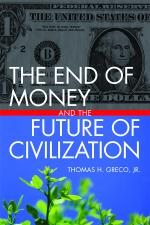 as relevant today as it was when first published the printed book has been out of print for several years. But, having had the rights reverted to me by my publisher, I am making the entire book available for free in PDF format. You can read it or download it HERE. If you would like a hard copy of the first edition used copies can still be found on Amazon.com, Abe books, Thrift books and elsewhere.
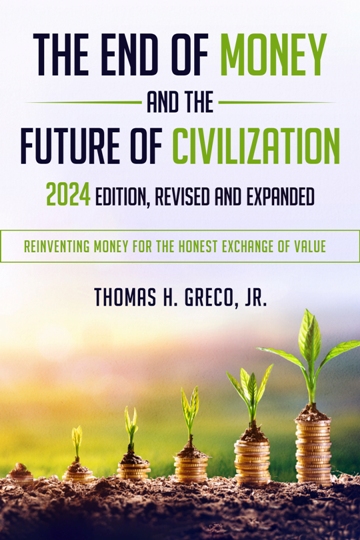 Better still, you can avail yourself of the new revised and expanded 2024 edition which I have been working on for almost two years and is almost complete. Eighteen chapters have already been posted and can be freely read or download HERE.
My previous books, as published, may be freely accessed in digital format by clicking the title below.
Money: Understanding and Creating Alternatives to Legal Tender (2001)
New Money For Healthy Communities (1994)
Money and Debt: a Solution to the Global Crisis (1980)
Collectors may find used and some new print copies of my books as published, on amazon.com and elsewhere online. Start by clicking on the title below:
Money: Understanding and Creating Alternatives to Legal Tender (2001)
 Beyond Money
 Beyond Money